Waking Up

Around 4 million people, many of them students, but all ages, protested around the world yesterday.  They gathered to speak in protection of the planet on which we live, an organism that needs to function successfully in order for us to survive.   

On June 20, 1979, Democratic president Jimmy Carter had 32 solar panels installed on the White House roof to use the rays of the sun to heat water.

When Republican Ronald Reagan took office in 1981, he immediately had them removed.  

The United States has produced more emissions than any other country since the start of the industrial age and yet we have a president now rolling back 85 environmental regulations.

Reading the list makes me sick, so maybe we’ll expire in an ingestion of disgust so it won’t matter that our air is unbreathable and our water polluted.

Meanwhile, 16 year old Greta Thunberg has stepped out of the classroom to speak.  Our leader has risen, our Joan of Arc.

Each of us is a process; our planet is a process, a “systematic series of actions directed to some end”.  We’re not helpless; we’re here with a purpose, a community of interdependence stimulated and programmed to evolve.

On Wednesday, Greta said this to members of Congress in the House Ways and Means Committee.

“This is not the time and place for dreams, this is the time to wake up. This is the moment in history we need to be wide awake.”

“This is the biggest crisis humanity has ever faced, you cannot solve a crisis without treating it as one. Stop telling people that everything will be fine. As it looks now, everything won’t be fine.”

“If it continues like that we’re not going to get anywhere, actually transform words into action — the action we need now.”

And on this beautiful day, as we in the Northern hemisphere tilt toward fall, the leaves are changing color, preparing to drop, and in that letting go, enrich and protect the roots in the ground.  They show us the way. We can drop into awareness of the crisis, leaving the branches of support open and clear. We’re led by nature, and the natural processes that have given us Greta. She inspires us to act.
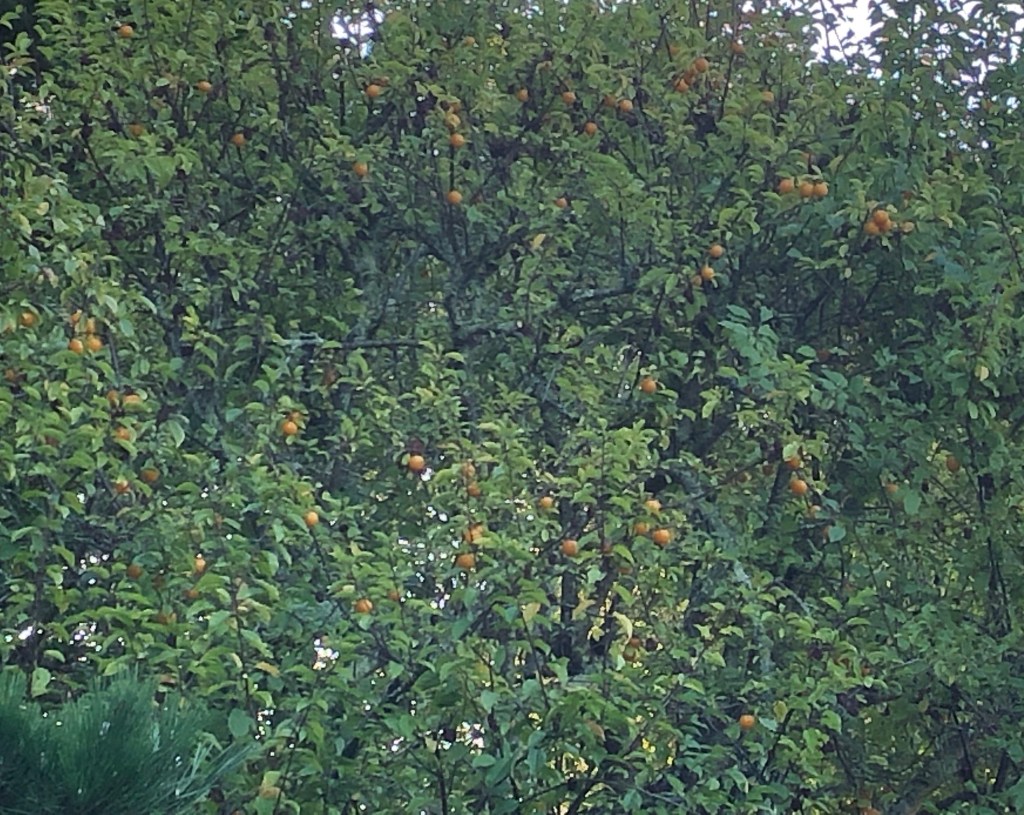
Plums drop, followed by leaves


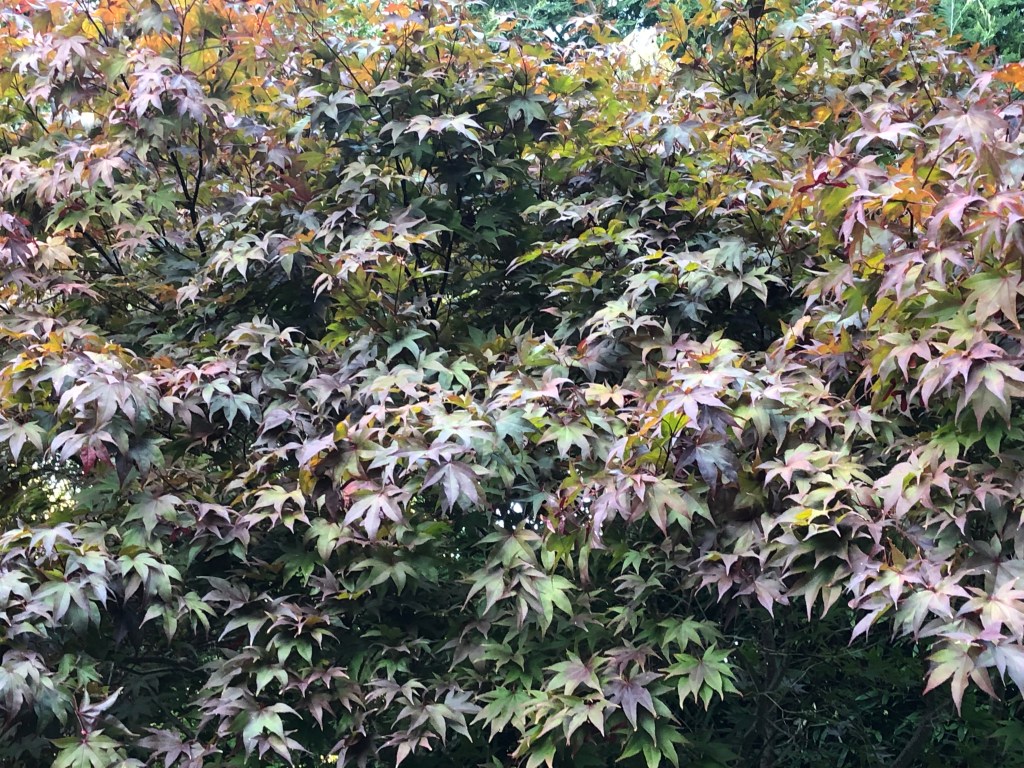
Leaves changing color before they part from their branch of the tree


Mother Earth

It’s Global Climate Strike Day.  It’s beautiful here. Mother Earth is offering her support for the day, the early morning light touched with gold.

Yesterday I walked in twilight through the forest duff of Old Mill Park to the Mill Valley library which looks out from full length windows onto redwood trees.

That might be enough for an evening but I was there to hear two poets read.  

First, Matthew Siegel read, and then,  Padraig O Tuama, an Irish poet, who headed Corrymeela for years.

Unfamiliar with it, I checked out their website: https://www.corrymeela.org

Corrymeela is Northern Ireland’s oldest peace and reconciliation organisation. We began before “The Troubles” and continue on in Northern Ireland’s changing post–conflict society.  The organisation grew organically from the original Community members, and today almost 40 full–time staff and dozens of volunteers work alongside the eleven thousand people who spend time in our residential centre every year. 

Following the reading, there was a question and answer period.  

Both men agreed that Ilya Kaminski is the poet of a century.  If you haven’t read his poetry, do.

They spoke of knowing and exploring the one thing, that one thing that each of us comes back to when we write to explore, discover, and share.  

Padraid said, Poems have a certain hunger around which they circle.  

He also said spirituality comes from the breath, that language helps us breathe, so write what people can turn to,  do things with words that help us breathe, then finalize a poem with a spark or a demand. I sit with that, no small task, though perhaps trusting the breath, it is.

Naturally politics had to come up when an Irish poet is in the room.  Right, now the world is twisted on arrogance. As you might imagine, he didn’t have anything good to say about Britain, the Tories, or Brexit.  He called the explorer Captain James Cook, a murderer. He says Ireland didn’t have a potato famine; they had a policy famine.  

They were asked if cell phones are destroying writing.  They pointed out that texting is writing. We send emails.  We are writing, and writing is about attention, and that is the point, attention.  

They both agreed they are inspired by this poem by Rilke, and by Emily Dickinson, of course.

Widening Circles

Rainer Maria Rilke

I live my life in widening circles

that reach out across the world.

I may not complete this last one

but I give myself to it.

I circle around God, around the primordial tower.

I’ve been circling for thousands of years

and I still don’t know: am I a falcon,

a storm, or a great song?

Book of Hours, I 2

Circling – vision moving in and out


That leads me to Jane Hirshfield’s poem, the perfect poem for this day. 

May our lungs breathe in the clean air of fact.

ON THE FIFTH DAY

by Jane Hirshfield

On the fifth day

the scientists who studied the rivers

were forbidden to speak

or to study the rivers.

The scientists who studied the air

were told not to speak of the air,

and the ones who worked for the farmers

were silenced,

and the ones who worked for the bees.

Someone, from deep in the Badlands,

began posting facts.

The facts were told not to speak

and were taken away.

The facts, surprised to be taken, were silent. 

Now it was only the rivers

that spoke of the rivers,

and only the wind that spoke of its bees,

while the unpausing factual buds of the fruit trees

continued to move toward their fruit.

The silence spoke loudly of silence,

and the rivers kept speaking,

of rivers, of boulders and air. 

In gravity, earless and tongueless,

the untested rivers kept speaking.

Bus drivers, shelf stockers,

code writers, machinists, accountants,

lab techs, cellists kept speaking.

They spoke, the fifth day,

of silence.

The tides move in and out of the marsh – view from a rickety bridge


Celebration

I’m out early this morning, the moon still up, already moving to close itself to half, and the stars shining.

A friend shares that she’s been on a seven day rafting and camping trip in the Grand Canyon, sleeping under the stars, no tent.

I look up and celebrate the luxury of enclosure in canyon walls that open to the sky.

Meanwhile I’ve looked into the stones in the bay, a different type of star.  Life dances in my chest.   

Stones sparkle in ripples of water


Great White Egret in the Marsh


Windmills

It’s raining, pure delight, and I’m with windmills, and the simplicity of the discovery that changed the world, and still can, and does.

Thinking about windmills brings me to the story of Don Quixote, “tilting” at windmills. It also reminds me of David Brooks inspiring book, “The Road to Character”. Brooks brings forth the lives of people who’ve influenced and changed our world. He mentions over and over again the wisdom obtained from the classics, novels by Tolstoy, Dostoyevsky, George Eliot, and others.

I think now of these novels as windmills, harnessing the breath of great minds to grind and turn thought into path.

Harnessing wind to grind our daily bread

Leaning Back

Today I lean back, lean back to receive.  Physically and psychologically, I’ve felt the momentum in leaning back to then, when called, lean forward, and rise.

I’m entranced with Greta Thunberg, a 16 year old climate activist claiming her autism on the spectrum to Aspberger’s, as her Superpower.

She is clear, no dissonance on what she knows is true, and she leads the way.

Friday, September 20th, is a day to lean, rise, and stand on the bench of her example, as we rock connection with the waves of change.  

Waves solidify a place to sit and stand


Cove in the meeting of water and land


Snowy Egret

Do you see the Golden Slippers?  I walked to the bay this morning before my doctor appointment.  This guy was super friendly as he waited for lunch. He wasn’t using his slippers to stir up prey, seemed content to wait on the rocks.

Waiting for lunch


At the end of the 19th century, wading-bird feathers were worth more than $30.00 an ounce, twice the price of gold.  The American Ornithologists Union estimated as many as five million birds were killed a year.  

Why?  To decorate women’s hats.  

The feathers of the Snowy Egret, Golden Slippers,  were especially prized for their softness and delicacy.   This could have led to extinction but in 1903 President Theodore Roosevelt established the nation’s first national wildlife refuge on Pelican Island, Florida, specifically to protect wading birds from plume hunters.  As more protections were put in place, the birds were saved, and our waterways are augmented with a niche filled with beauty and grace.

Time to pursue a tidbit or two


Appreciation

I’m reading a poem by Jim Daniels called “Cosmetic”.  In the poem his mother who’s had good vision for 75 years and is now legally blind has had eyebrows tattooed above her eyes.  She wants to know how they look. He realizes he could tell her anything.

He continues,  “she’s rounding everything off into simple shapes”.  

At my age, almost seventy, I am grateful for each moment and what I’m able to do.  I recognize the gift of being able to sharpen an eyebrow pencil and draw on brows, but what about when I can’t.  Will I simply keep my bangs long, or will I be as I was when I went through chemotherapy, an open lake?

And are eyebrows what we see when we look at another, or is it energy and enthusiasm pouring through, an inner light, as though we look into a cave, and see, yes, there is light.  There is light.  

Light


Flow

Fog moved in while I slept.  I felt her coming so I closed windows and doors before I hopped into bed.  I’d been outside with the moon and stars, beacons and now the fog is a kiss, a soothing mist.  I know what it is to be a flower wet with dew that will lift.

I stayed in bed this Sunday morning; it was still dark. I opened and closed my eyes, played with reception, allowing what was here to come to me. 

Simplicity, noticing, opening, awareness.  What am I receiving?  And then, there was no separation; my hands rose, light.  

I considered the words that so affected Charlotte Selver when she heard them from Elsa Gindler.

“Do you feel the air through which you move?”

And in feeling the air, the weight of it, I thought, and “Do I feel the air that moves through me?”

And there I played, a dance of movement, air and me, relationship. Again, I was with the expansion I felt with my brother’s passing, doors opening until there are no doors; there are no walls.   

The words of William Blake came to me. “If the doors of perception were cleansed then everything would appear to man as it is, Infinite. For man has closed himself up, till he sees all things through narrow chinks of his cavern”.

Is that how I see? And perhaps for a moment there was a glimpse simply received.

And then the kitties called. It was breakfast time. After rising, feeding them, and watching water drip through a filter of coffee, and then, adding cream, I walked outside and was brought to the contemplation of non-duality, and these words of Sri Nisargadatta Maharaj from his book I Am That. 

“Love says: ‘I am everything’. Wisdom says: ‘I am nothing’. Between the two my life flows.”

Between the two, my life flows.  

Cascade Falls in Fall


Serenity

Yesterday I met a friend at Tennessee Valley.  I was early so I placed a blanket under the trees and lay on my back looking up, listening to chirps, and feeling the breeze.

We met and walked in unprecedented heat to the beach.  98 degrees, I learned later. We like to walk and talk because as is said, Solvitur Ambulando.  “It is solved by walking”.

What is the “it” you might ask, and in this case, there was no it, just an opening to connect with ourselves, each other, and the landscape of which we’re part.

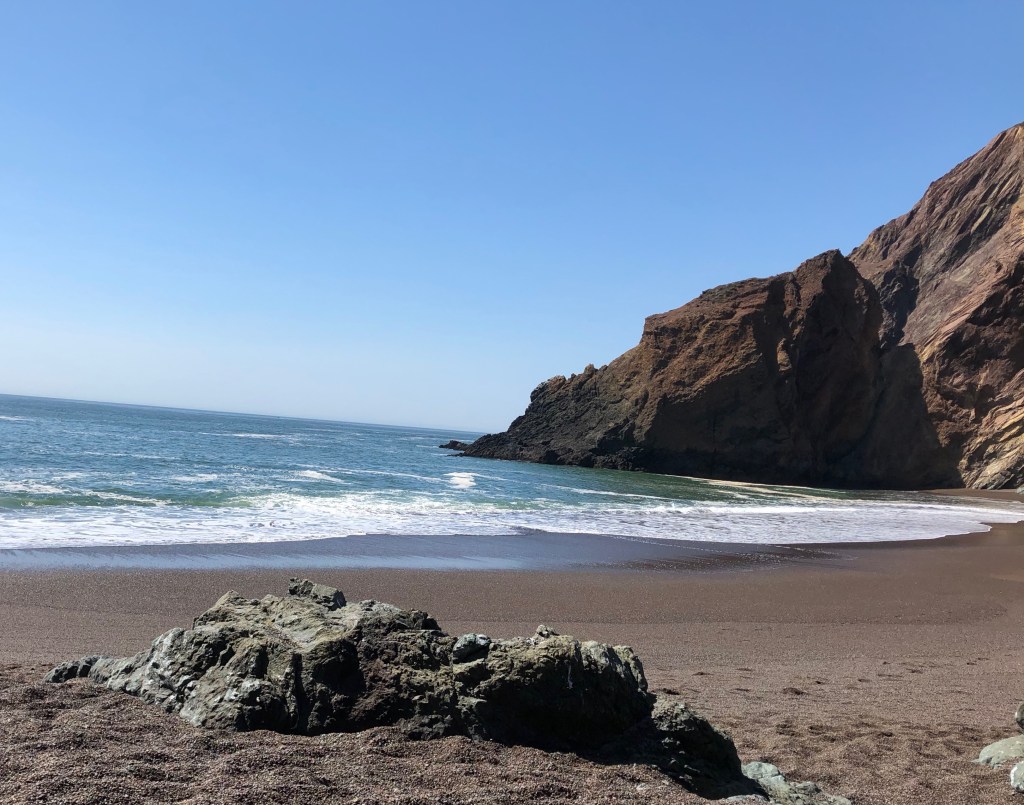
When we got to the ocean, we looked for shade, and found a little inlet, not a cave because it was open at the top but it allowed us to sit in the shade of the cliff.  The rock held water that dripped down my back.

When I mentioned still grieving my brother’s death, she asked what that felt like, and at first I thought of what I’d read, that grief is like waves, comes and goes like waves, but then I realized it was something more.  It was expansiveness.

I’m feeling my brother open me to something more, to spaciousness. It’s the cosmic joke perhaps, the huge laugh, and maybe that’s what the Big Bang was, and is, a giant “guffaw”. Who knows but I think we’re designed to laugh, as much as we can, even as we recognize happiness is helping others, because in helping others, we help ourselves because we are all One.  

Looking up at trees


Looking north from Tennessee Valley Beach


Looking south


Looking out from our protected and shaded spot


Serenity at the beach


Full Harvest Moon

Our days and nights are warm for now, the ripening before the dip to the shortest day and longest night, and then return to spring. We circle like the roundness of the moon as it shines in the sky tonight.

A friend shared this quote by Alan Watts with me, and I was reminded that he was a student of Charlotte Selver, my teacher of Sensory Awareness, and that they taught together, sometimes rejoicing in tossing sticks off his houseboat in Sausalito and watching them float with the tides. Excitement, joy, and fulfillment are everywhere.

“As it is, we are merely bolting our lives—gulping down undigested experiences as fast as we can stuff them in—because awareness of our own existence is so superficial and so narrow that nothing seems to us more boring than simple being. If I ask you what you did, saw, heard, smelled, touched and tasted yesterday, I am likely to get nothing more than the thin, sketchy outline of the few things that you noticed, and of those only what you thought worth remembering. Is it surprising that an existence so experienced seems so empty and bare that its hunger for an infinite future is insatiable? But suppose you could answer, “It would take me forever to tell you, and I am much too interested in what’s happening now.” How is it possible that a being with such sensitive jewels as the eyes, such enchanted musical instruments as the ears, and such a fabulous arabesque of nerves as the brain can experience itself as anything less than a god? And, when you consider that this incalculably subtle organism is inseparable from the still more marvelous patterns of its environment—from the minutest electrical designs to the whole company of the galaxies—how is it conceivable that this incarnation of all eternity can be bored with being?”

~ Alan Watts, The Book: On the Taboo Against Knowing Who You Are

Enchantment – en chant meant