Today I hear romping in the yard below. I look over the side of the deck, and seeing a deer, grab my phone, and trot downstairs – not just one deer – six. Six – a gift shared.
The quieter you become, the more you can hear.
Ram Dass
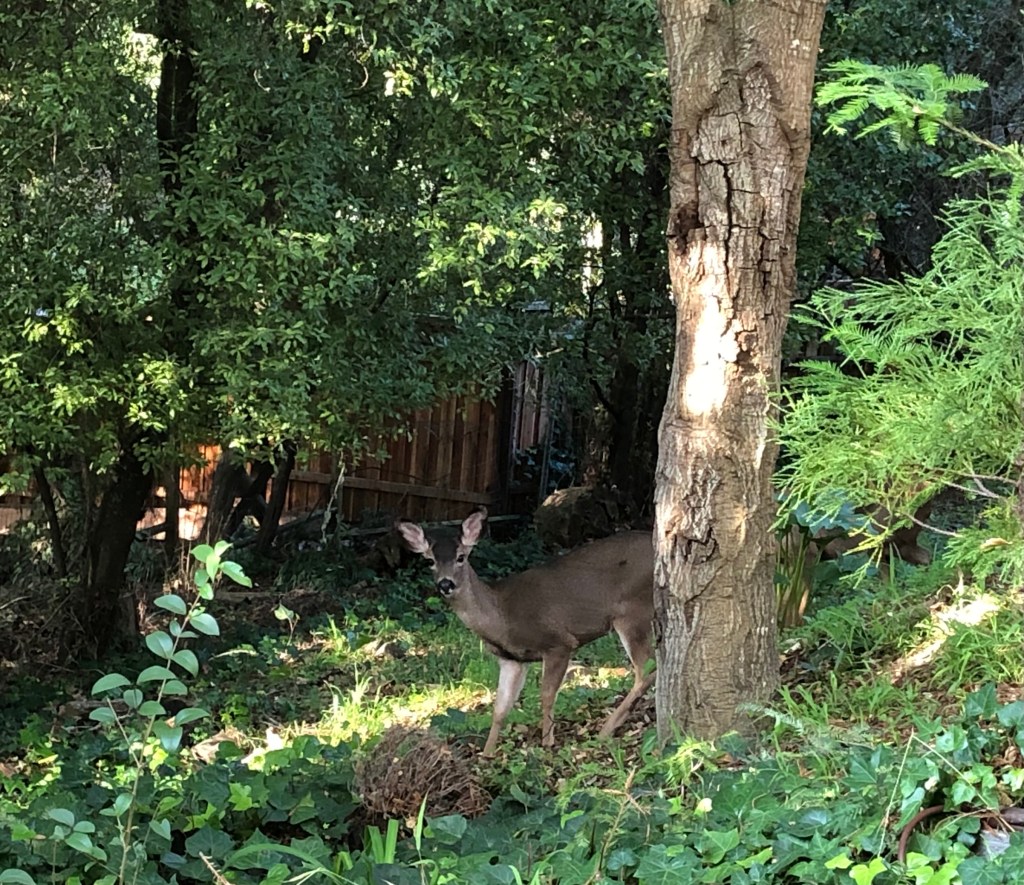
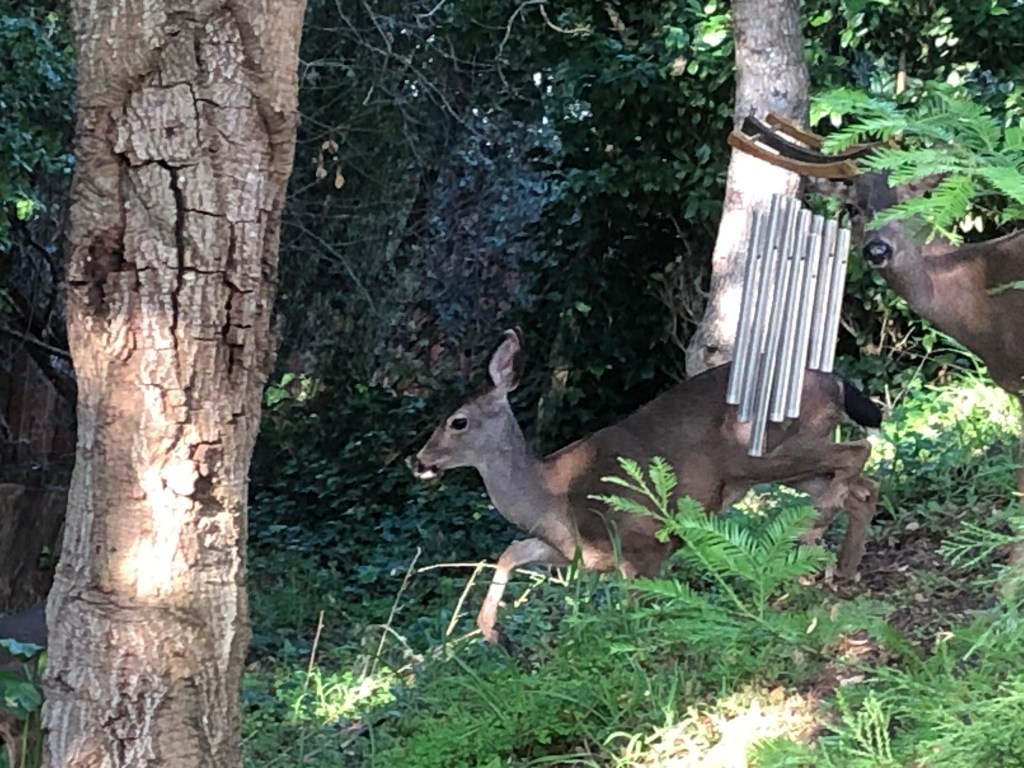

Today I hear romping in the yard below. I look over the side of the deck, and seeing a deer, grab my phone, and trot downstairs – not just one deer – six. Six – a gift shared.
The quieter you become, the more you can hear.
Ram Dass
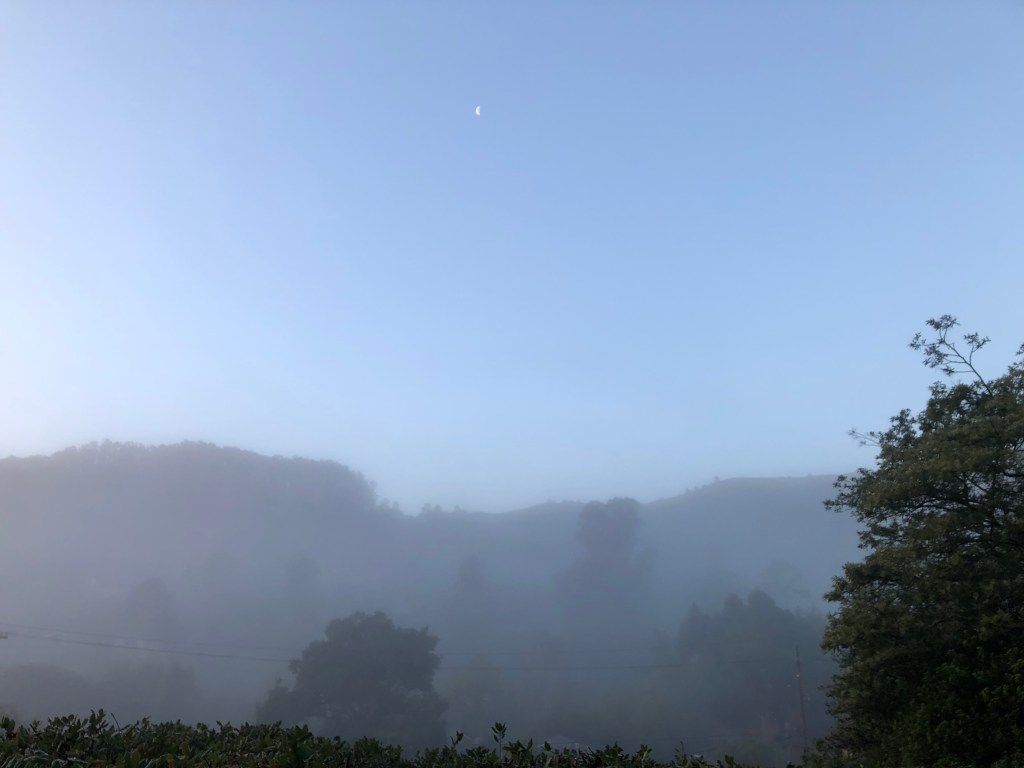
The fog is in and outside my home I see the redwood tree and the oak but other than that, I’m gently tucked. I hear the fog horn and the cackling caws of crows.
Lately, friends have lost their mothers and I find myself remembering back to my own mother’s passing February 18, 2005.
Loss of mother is loss of the womb in which we were conceived and nurtured. When mother goes, we’re dropped into, or perhaps opened into, a larger womb, and still there is the pain of squeezing through that canal and trusting the opening out.
After she died, I went each week to Pierce Point, a piece of land in Pt. Reyes that divides Tomales Bay and the ocean. Tomales Bay divides two tectonic plates so one can be on the plate carrying Los Angeles north, or the other. For me, it is the place to be when someone I love dies.
And then like that, the fog clears – the moon a slice in the sky – a stanza – a poem –
pierce point
mother dies
I cross to this land mass
each week
wanting connection
with the other side
I feel her here with the Tule Elk -
Tomales Bay - ocean waves -
her death a gentle quake-
birds sang as she died
quivering
as she passed -
With the passing of Thich Nhat Hanh, I’m aware of the portal between life and death as though yes the plates slide open for us to see. I’m with his poem “Call Me By My True Names”. May the cultivation of compassion and empathy be our guides.


I was first introduced to the compassionate wisdom of Thich Nhat Hanh in 1993. I was in a Sensory Awareness workshop at Green Gulch Zen Center. I heard about this gentle monk engaged in a movement of peace. He has been my guide over the years in the practice of forgiveness and expansiveness. He was able to forgive what happened in his homeland, Vietnam. He set a gentle example which will not die with his death for as he wrote in his book, No Death, No Fear, : “Birth and death are only notions. They are not real.”
In 2013, speaking at Google headquarters in Silicon Valley, he said:
“Do not try to find the solution with your thinking mind. Nonthinking is the secret of success. And that is why the time when we are not working, that time can be very productive, if we know how to focus on the moment.”
Even when tied in a thousand knots, the string is still but One.
– Rumi
I’m with the passing/passage of Thich Nhat Hanh.
My eyes are moist in this morning’s meditation. I feel joy and sorrow come together in the tender center of the heart, tears, liquid love – oneness. I remember how clear that was when I walked in the mountains of Nepal, hands coming together, namaste, how clear that can be each moment, each day.
Namaste – I see the Spirit in you. You see the Spirit in me. The Divine Light in me bows to the Divine Light in you. Namaste.
Thich Nhat Hanh:
“The miracle is not to walk on water. The miracle is to walk on the green earth, dwelling deeply in the present moment and feeling truly alive.”
And in the passage and energetic distribution of Thich Nhat Hanh, I am flower, mountain, water, still and moving, space opening and closing, massaging with each breath – Gratitude, Ease, and Peace.
The beloved teacher, guide, loving presence, and inspiration for Interbeing has passed away.
I open a little book I keep here on my desk, A Handful of Quiet, Happiness in Four Pebbles. The practice is to gather four pebbles, and let each one represent a flower, a mountain, still water, or space.
Then, the meditation is:
Breathing in, I see myself as a Flower.
Breathing out, I feel Fresh.
Breathing in, I see myself as a Mountain.
Breathing out, I feel Solid.
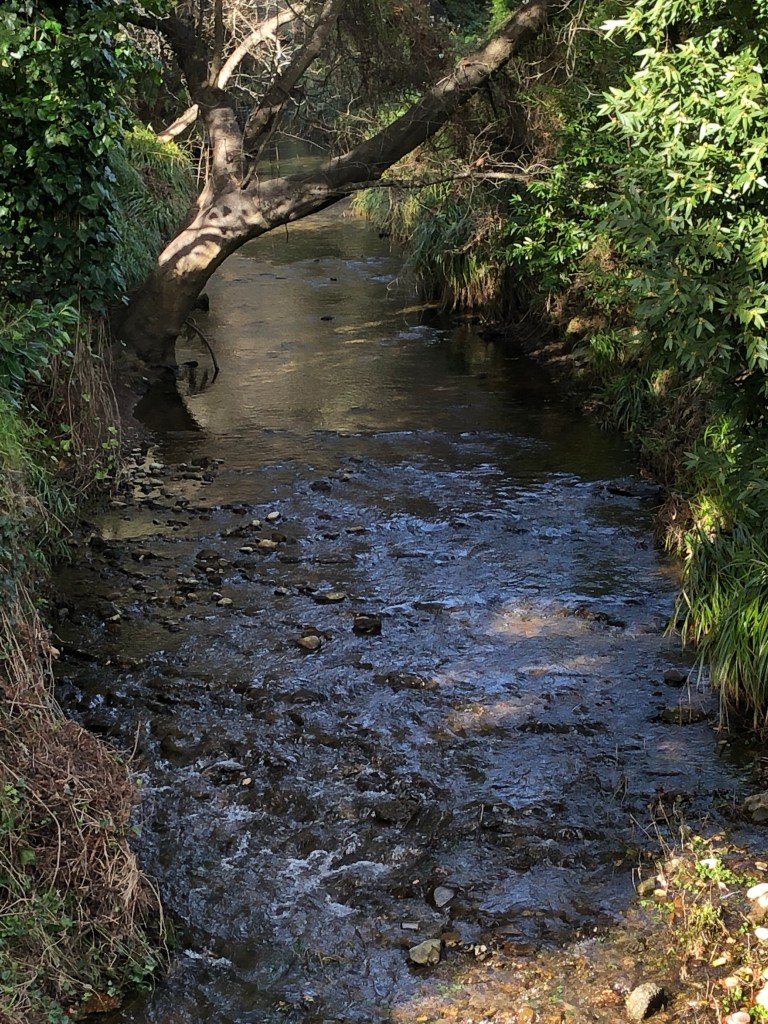
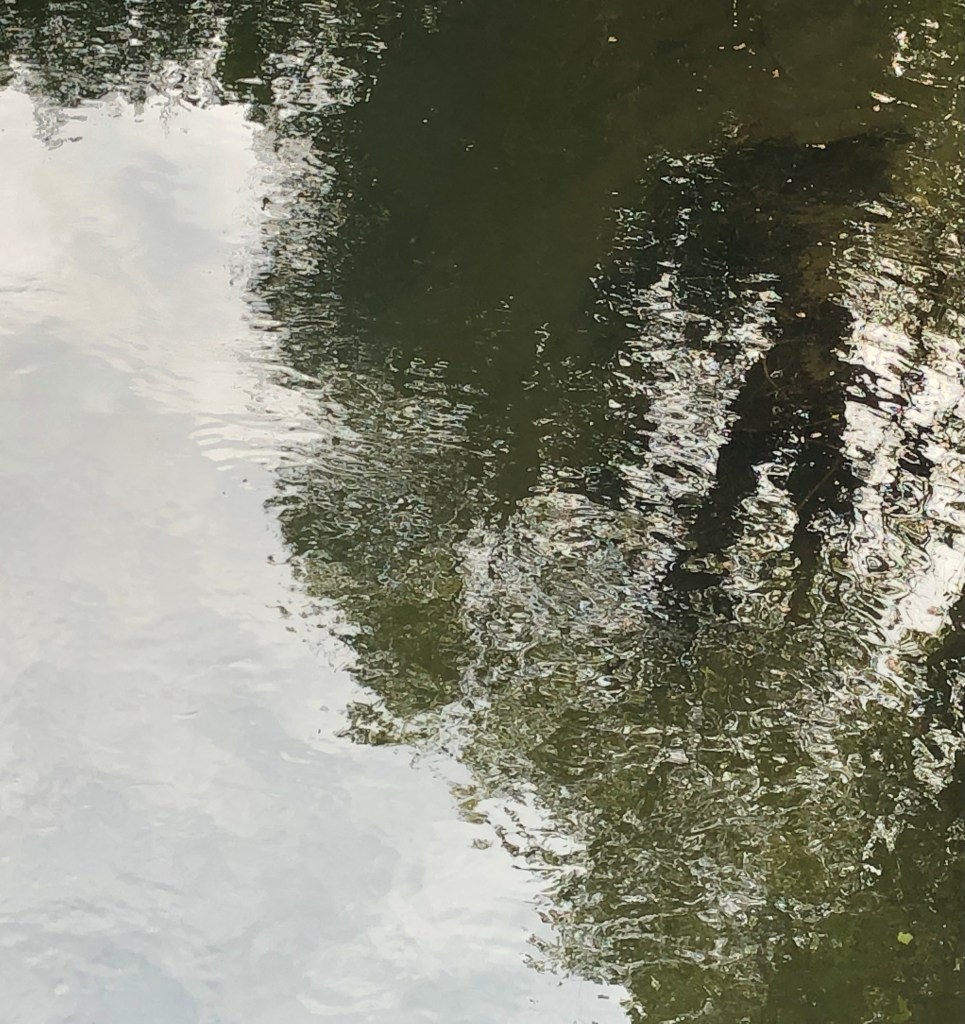
Breathing in, I see myself as Still Water.
Breathing out, I Reflect things as they are.
Breathing in, I see myself as Space.
Breathing out, I feel Free.
I start this day with the words from Mary Oliver’s poem “Sometimes”.
Instructions for living a life:
Pay attention.
Be astonished.
Tell about it.
And she did.
It’s still dark here at 6:15. In summer, it would have been light long ago. What am I meant to do with the silence, the integration of darkness with the coffee I sip, and all that brings coffee, connection and warmth to me?
I sit with Ajahn Chah’s words, “Even chickens sit.”
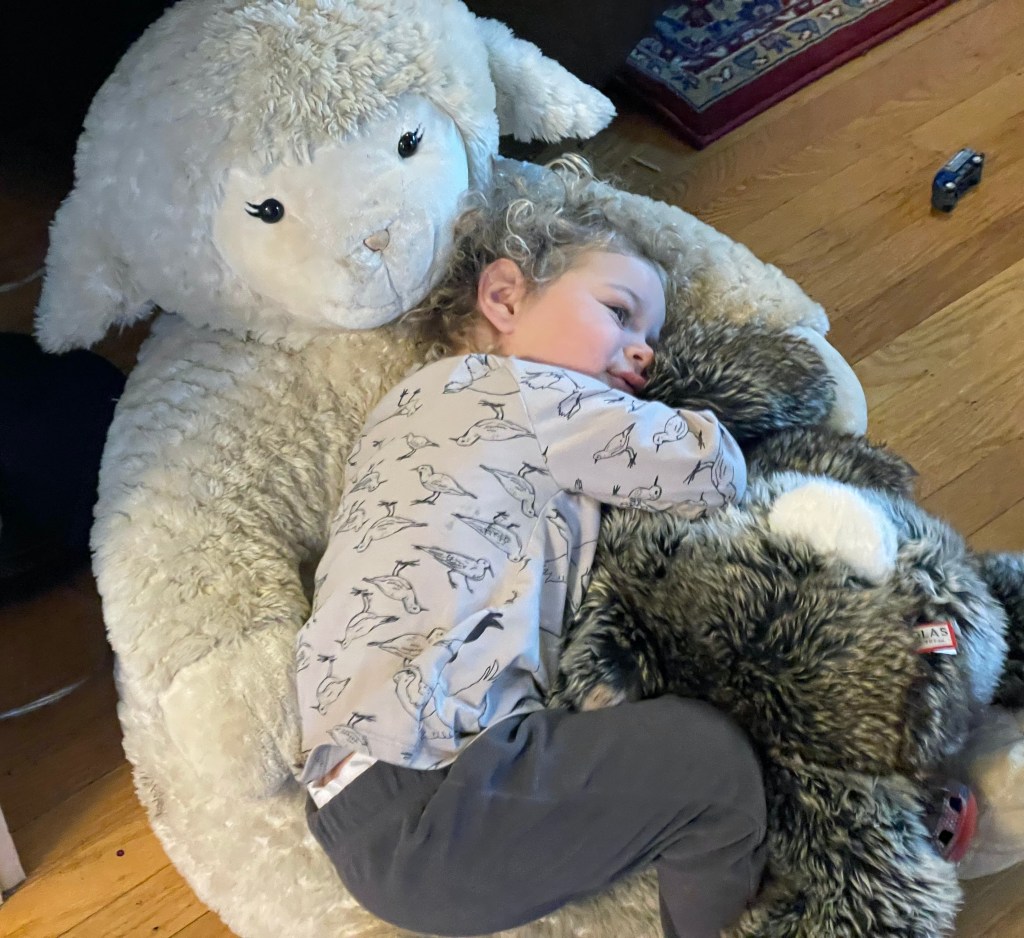
And so I sit with the image of my roost and the eggs that need protecting in the rhythm of my heart.
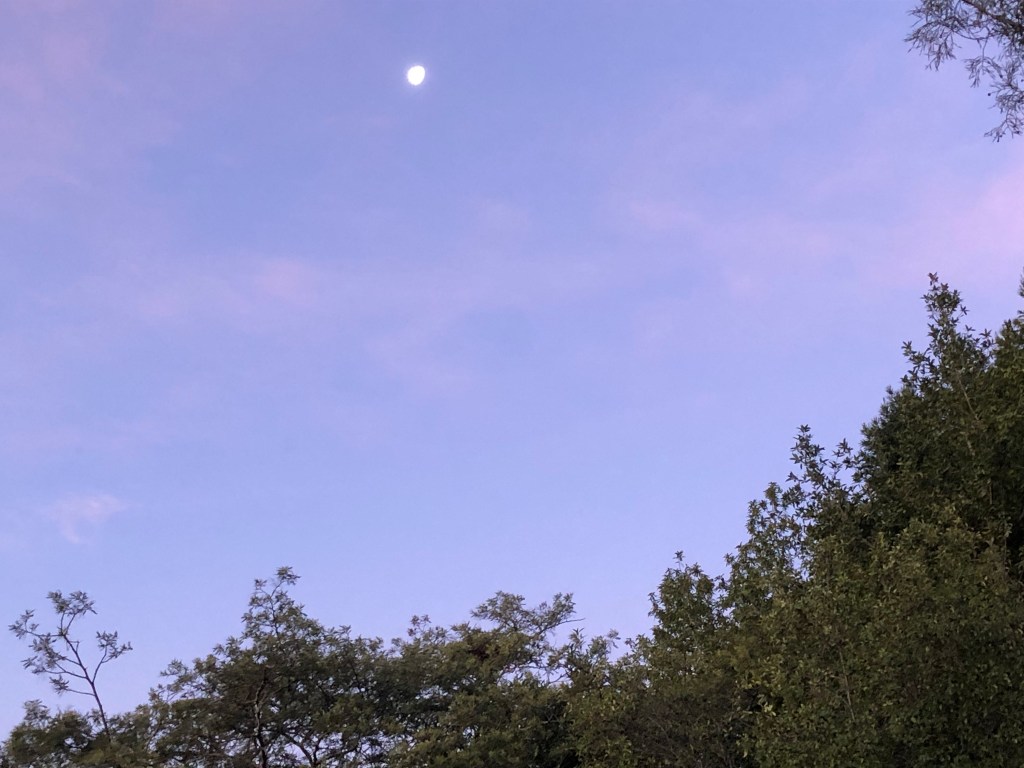
The last two nights I’ve awakened at 1 in the morning and risen to bathe in the full moon, the Wolf moon light.
I meditate, awake in silence. Words of Thich Nhat Hanh accompany me.
“People say walking on water is a miracle, but to me walking peacefully on the earth is the real miracle.”
“Realize that silence comes from your heart and not from absence of talk.”
Now, today, these words of Anton Chekhov come my way.
“Don’t tell me the moon is shining;
show me the glint of light on broken glass.”
In “An Unbroken Sequence”, The Dalai Lama and Thubten Chodron write:
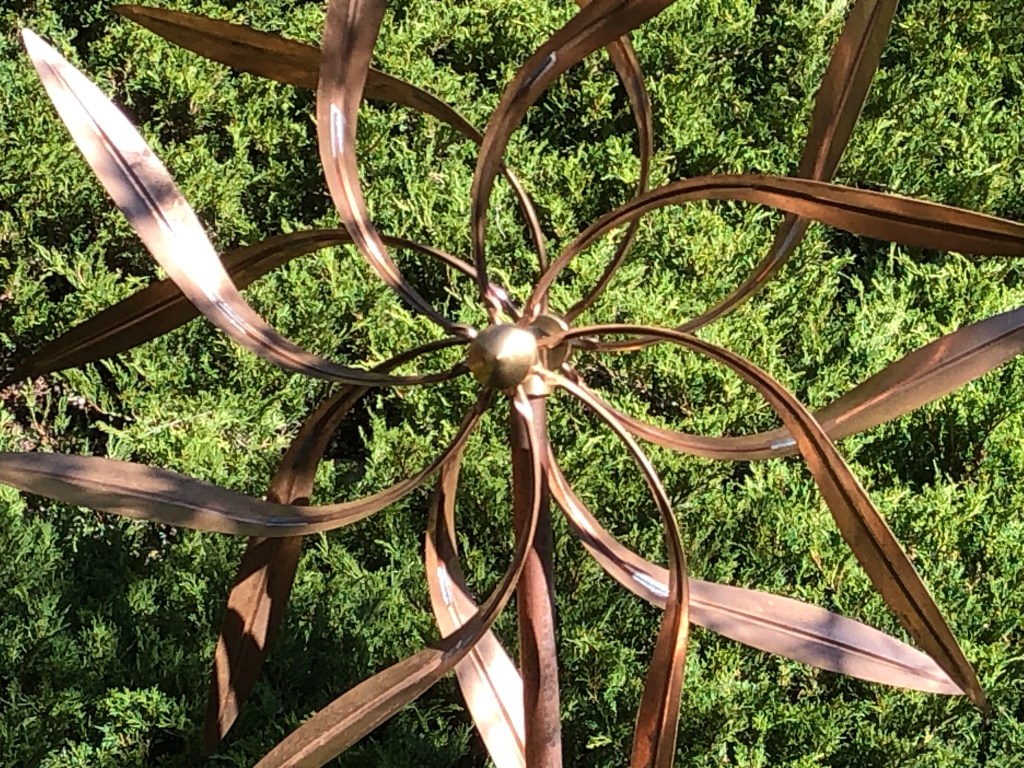
A stable, solid body is a mental image superimposed onto a stream of events in the same way that a spinning propeller is seen as a circle. The constant succession of discrete acts of cognition or feeling appears as a monolithic event, just as the rapid change of frames in a film appears as a smooth continuum.
And yet, we often pull ourselves apart to see ourselves as separate, as separate blades or leaves rather than recognizing we are one tree, one world.
My friend Pamela sent me a link to an article by Richard Powers.
https://emergencemagazine.org/essay/a-little-more-than-kin/
I suggest you read it all, but here’s a taste.
“We’re now in the middle of a family emergency that will test all family ties. Only kin, and lots of it, from every corner of creation will help us much in the terrible years to come. We will need tales of forgiveness and surprise recollection, tales in which the humans and the nonhumans each hold half a locket. Only stories will help us to rejoin human to humility to humus, through their shared root. (The root that we’re looking for here is dhghem: Earth.)
Kinship is the recognition of shared fate and intersecting purposes. It is the discovery that the more I give to you, the more I have. Natural selection has launched all separate organisms on a single, vast experiment, and kinship glimpses the multitudes contained in every individual organism. It knows how everything that gives deepest purpose and meaning to any life is being made and nurtured by other creatures.
Can love, in its unaccountable weirdness, hope to overcome a culture of individualism built on denying all our millions of kinships and dependencies? That is our central drama now. It’s the future’s one inescapable story, and we are the characters who will steer that conflict to its denouement.
To find the stories that we need, we would do well to look to the kinship of trees. Trees signal one another through the air, sharing an immune system that can stretch across miles. They trade sugars and secondary metabolites underground, through fungal intermediaries, sustaining one another even across the species barrier. But maybe such communal existence shouldn’t be all that surprising. After all, everything in an ecosystem is in mutual give-and-take with everything else around it. For every act of competition out there, there are several acts of cooperation. In the Buddha’s words: A tree is a wondrous thing that shelters, feeds, and protects all living things. It even offers shade to the axe-men who destroy it. Incidentally, the same man once said: The self is a house on fire. Get out while you can.”
At Commonweal, a huge tree fell. It would have damaged, if not destroyed a residential building, but a palm tree caught it and saved the building. Luck, or kinship, awareness, and communication?

It’s a day to honor courage. The word comes from the French, couer, the heart.
We honor one man today, Martin Luther King, Jr.
In 1957, he said:
“I am convinced that love is the most durable power in the world. It is not an expression of impractical idealism, but of practical realism. Far from being the pious injunction of a Utopian dreamer, love is an absolute necessity for the survival of our civilization. To return hate for hate does nothing but intensify the existence of evil in the universe. Someone must have sense enough and religion enough to cut off the chain of hate and evil, and this can only be done through love.”


Maria Popova shares wonderful and intriguing thoughts in The Marginalian. Today I read her thoughts on how we deal with death. She quotes from Alan Lightman’s book Mr. g: A Novel about the Creation.
Alan Lightman:
A woman dies. At that moment, there were 3,147,740,103,497,276,498,750,208,327 atoms in her body. Of her total mass, 63.7 percent was oxygen, 21.0 percent carbon, 10.1 percent hydrogen, 2.6 percent nitrogen, 1.4 percent calcium, 1.1 percent phosphorous, plus a smattering of the ninety-odd other chemical elements created in stars.
In the cremation, her water evaporated. Her carbon and nitrogen combined with oxygen to make gaseous carbon dioxide and nitrogen dioxide, which floated skyward and mingled with the air. Most of her calcium and phosphorous baked into a reddish brown residue and scattered in soil and in wind.
Released from their temporary confinement, her atoms slowly spread out and diffused through the atmosphere. In sixty days’ time, they could be found in every handful of air on the planet. In one hundred days, some of her atoms, the vaporous water, had condensed into liquid and returned to the surface as rain, to be drunk and ingested by animals and plants. Some of her atoms were absorbed by light-utilizing organisms and transformed into tissues and tubules and leaves. Some were breathed in by oxygen creatures, incorporated into organs and bone.
He continues on and I tempt you into reading her whole article, and then the book with these words.
And the individual atoms, cycled through her body and then cycled through wind and water and soil, cycled through generations and generations of living creatures and minds, will repeat and connect and make a whole out of parts. Although without memory, they make a memory. Although impermanent, they make a permanence. Although scattered, they make a totality.
 Cathy's Blog!