Compassion

I’m reading a book called Lotus Girl by Helen Tworkov.  It’s a memoir that gives a history of Buddhism coming to the West.  Where I am now she is discussing the bardos with Yongey Mingyur Rinpoche.  She is adjusting to her aging process and realizes we go through some of the stages of being, adjusting to impermanence and change, the bardos, while alive. She’s in the “Bardo of Old Age”. 

When she asks Yongey Minyur Rinpoche about the bardos and tells him about George Saunders book, Lincoln in the Bardos, he asks, “What’s a Lincoln?”

Of course, one might answer a car but it shows how much we rely on what we consider “common knowledge” in our conversations.

Last night when I read Trump’s garbled and incoherent reply to a question on childcare, I felt sorry for a man who is being primed to run for president when he is clearly incapacitated.  I’m grateful Biden was persuaded to step down, and now when I read the words of a man who is off the rails, compassion swells.  Why is he being protected?  So he can be manipulated.   Elon Musk would essentially be our president if he were elected, Elon and other fascists.  

What is it to keep someone propped up for your own benefit?

Not acknowledging Trump’s deterioration is an inability to honor and see the cycles of life and death, the evolving transformation that connects the two.  I walk more slowly now, think more slowly, as I pause and connect the dots to flow and dissolve, and, in this,  I give my family time to see, and adjust, appreciate, and gather around impermanence and change.  I am a campfire, once ablaze, now softening to a glow for toasting marshmallows, turning softly and tenderly to ash.

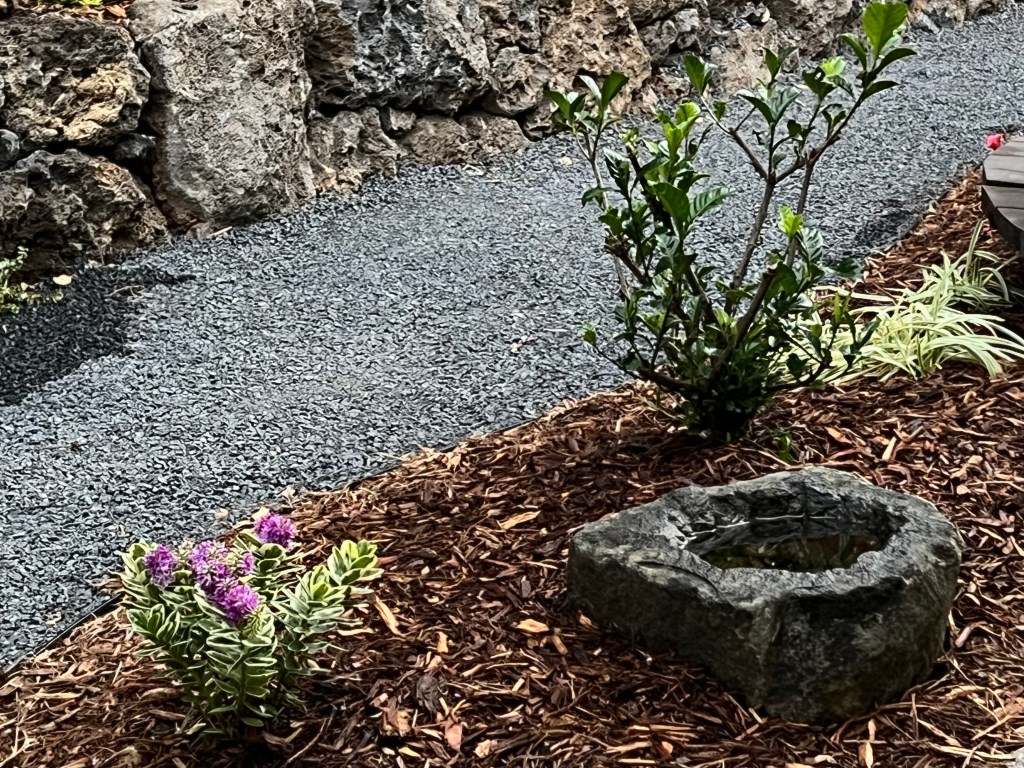
I savor my rejuvenated garden.  The older plants are vibrant with new soil and mulch. They are teachers for the young ones now brought in. They are elders sharing their wisdom on seasons, impermanence, adaptation, and transformation. Grace!

Serenity

Receiving

I was in a discussion today that focused on “Conversing and Interrupting”.  How do we enter an ongoing conversation, discussion, or interactive group?  How do we find our part, claim our space, or do we sit back in childhood programming of being seen, not heard, and told not to interrupt? And in that, are we actually seen? Are we seeing ourselves?

Instead of the word “interrupting”, I wrap in the words converging and engaging. These words give me a gentle entry, a cushion for reflection on the subject of conversation with others and with myself.

How do I bring myself into a group, or into the diverse voices I am?  How do these inner voices converge, engage, and interact?  Do they shout or whisper, speak with invitation or confrontation, flow or contract?

As His Holiness the Dalai Lama says, “My religion is kindness.”

How am I kind to myself, and in that, others?

In the conversation today, we, who were of the age of wisdom, agreed that aging is humbling.   Where we once felt formidable, strong, and able to do anything and everything, now there is vulnerability. We have to ask for help.

On Wednesday, I was at the beach with a friend. We brought food and settled ourselves on the sand to watch the sun set. She went to open her water bottle. It wouldn’t budge. I tried. Nothing! And then a lovely young couple walked by, and my friend said to him, “You look strong. Do you think you could open this for me?” And he did, and he opened it so easily, the four of us laughed. It was so funny, and perhaps, as I type this a little sad, but isn’t that where we find humor, in the truth of what it is to be alive, and in the connectivity that vulnerability brings?

I’m with these words from The Power of an Open Question by Elizabeth Mattis Namgyel.

The way we know things depends upon the mind, nothing more. Most of us have moments of deep contentment when we don’t feel a need to alter, express, run from, or invest some special meaning in our experience in any way. Deep contentment shows us that, at least momentarily, our habit of cherishing and protecting ourselves from what we call “other” has subsided. In moments like these, we have stopped objectifying things.  We can let things be.  And when the mind rests at ease in this way, it accommodates everything, like space.  

Cave Creek, AZ