Noticing

It’s evening and I’m pausing before I journey to my neighborhood book group holiday potluck celebration.  

I’m with the words of the Persian poet Ghalib who wrote: “For the raindrop, joy is in entering the river.”

This time of year there is a dip to connect as we navigate the dark like twinkling lights.

Are we raindrops entering a river?   Perhaps we drop more noticeably into a river of time as we feel one year melt into the next.   

Lao Tzu said: 

“If you are depressed you are living in the past. If you are anxious you are living in the future. If you are at peace you are living in the present.” 

My intention is to live in the present and be peace.

Good Morning

I wake early today and go outside to look at the moon.  The owls are hooting and now I know this is the mating call of the Great Horned Owl I’ve been hearing, and male and female are back, and if all goes well, we will have baby owls in late March.   What an omen of Joy!

Yesterday I was watching the crows and the hawks screeching across the sky.  Was it battle or play? It looked like play as though each was perfecting its flight and hanging out as our weeks of rain lead to sun today.

Nature shines through more clearly with the leaves fallen and coating the ground.  Branches stroke the heart with their reach and bend.

I’m with this haiku by Issa this morning.  This is one translation.

Does the woodpecker

stop and listen, too?

evening temple drum 

May your day be one of beauty and peace!

Morning Sky to the East


Morning Sky to the South


Mother Nature

Yesterday I saw the play “Mother of the Maid”.  It was presented at my local theatre, and has also played in NYC with Glenn Close playing the mother of Joan of Arc.  Sherman Fracher who played her here was excellent. Written by Jane Anderson, the play explores what it is to be the mother of a saint.  What is it like when your teenager comes to you and says she has visions and is being commanded by Saint Catherine to put on armor, carry a sword, and lead an army? 

How does it feel to see your daughter put on pants at a time when that was forbidden? I was surprised to learn that though Joan of Arc was tried by the Catholic Church for heresy, the charge she was convicted of that led to her burning was violating the Biblical commandment of Deuteronomy 22.5, which says, “the woman shall not wear that which pertaineth unto a man.”

The power of the play is in showing what it is for parents to lose control of their daughter and yet stand by her through the unimaginable.  Her parents come across as saints.

Her mother Isabelle Arc walks 300 miles through mud and storms to see and support her daughter who has gone to court.  After her daughter is burned at the stake, she goes to Rome to talk to the Pope to ensure her daughter is acquitted of her supposed crimes and eventually canonized as a saint. This is a woman who couldn’t read or write but knew right and wrong, and love, true love.

At the end, the mother speaks of the beauty of what her daughter felt and touched on, and that is the beauty that is right here, in the flowers, soil, fellow creatures, and air.  It comes around to Mother Nature, and the soul we share.

Space

A friend asks, “How do we meet change?”

I reflect as I change the candles, tablecloth and kitchen towels from harvest colors of orange, olive green and gold to a subdued crimson.  I enter the season slowly, so crimson comes before a bright cherry and cheerful red.

Perhaps some transition is tossed at us, or we are tossed – a hurricane, fire, loss, and other times, we move slowly through the shift, the change.

I’ve always felt each day of December deserves a special nod, a softer, loving pat, some bringing forth of transition to full appreciation of the dark which will then swing us back toward light, “young light” as my friend Jane calls it, and yet, in this moment, all feels young, tender, fragile.

I treat December gently, but today I recall that there’s also a tinge of memory of 2005 when I began chemotherapy the Monday before Thanksgiving.  We retain memories and touch, like bread dough when it’s proofed and risen enough to be ready for the oven. We touch and the indentation comes up to meet us but not all the way, just enough.

It’s raining and I love the sound of rain as I read of soil, and how properly aerated, it holds water as a reservoir for growth.

From this article by Walter Jehne: 

https://thenaturalfarmer.org/article/pedogenesis-soil-cathedrals-living-membranes-and-industrial-hydroponics/

Without organic matter, mineral particles are packed closely together, very dense, with little or no space in between. Now life comes along, actively breaks the rock down, feeds the soil biology, and leaves organic detritus in there, and we can think of that detritus as little bedsprings between the mineral particles: they act as cements and glues, so it gives them structural integrity, but it also creates a sponge, because as those bedsprings push the particles apart, suddenly there are spaces, in the soil, full of air, and the soil grows upwards as it expands. (We know that from archeology because you have to dig down to enter the past.)

By making this change, nature has had a profound effect on that soil. By adding nothing, it has created this matrix of surfaces and voids. It is a bit like a cathedral. By having lots of bricks, and the cements or glues that can hold them together, we can make a cathedral. Now, you don’t go to a cathedral to look at the bricks, you go there to get in awe about the spaces, the voids, the nothing.

I pause to welcome this day, still dark, with some bricks of obligations to hold it together, but really what matters is the space, and there in the space is room for transition and change.

Sunday Ease

The day comes slowly to light, softly.

I’m with these words of Gary Snyder.  

As the crickets’ soft autumn hum

Is to us

so are we to the trees

as are they 

to the rocks and the hills.

Enter gently this new month.

Allow the fuel of compassion to move through each touch, the living, loving song of anchoring and swinging on moving in and out, the wings and heart of breath.  

Movement and Change

We enjoyed a beautiful Thanksgiving Day, and now, I softly percolate the day after.  The hills were green, and the sky magnificent with clouds and light as we drove south, and then, freezing temperatures brought us all inside to feast.  Now, I’m home aware that there’s one more day in November, and then we enter December, the last month of this year.

There’s a sense of pause and then a leap toward transformation and change.

In Chinese mythology, the Dragon’s Gate is located at the top of a waterfall cascading from a legendary mountain.  If a carp makes the jump at the top of the waterfall, it becomes a dragon.  

I’m reminded of a story I love, The Reluctant Dragon, written by Kenneth Grahame, and published in 1898.  A young boy meets a poetry-loving dragon and they become friends.  When the dragon is discovered by the local people, they call St. George in fear, and ask him to come and destroy the dragon.  

When St. George arrives, the boy introduces him to the dragon, who is not inclined to fight. The two decide to stage a fight.  The dragon is given an imaginary wound, and declared reformed by St. George. The people accept the reformed, poetry loving and peaceful dragon.

Tonight, I sit contemplating. What do I want and need in this upcoming last month of the year? I’m inspired to leap to the top of my waterfall dreams, and become what streams a fire of peace, poetry, connection, friendship and ease.  

Trees

In Timothy Egan’s book, A Pilgrimage to Eternity, he writes of walking through a section of the Via Fancigina where trees are revered.  

I love this passage.

The people of Lazio have long known that trees have feelings.  Recent studies suggest that many species experience pain, communicate with one another, send out distress signals, and lead complicated sex lives. None of this is a surprise to the forest dwellers of Etruria.  Every May, a Wedding of the Trees takes place atop nearby Mount Fogliano in front of thousands of dancing women and men. Two sturdy hardwoods, chosen for outward virility, are draped in ribbons and garlands, and sealed for life by a priest. The marriage is notarized, a way to ensure leafy fidelity through troubled years ahead. The union is pagan in origin, though that hasn’t kept the monks who live in a local nearby monastery from blessing the entire event.”

Last week I was in Mill Valley watching as trees were decorated for the Holiday season.  We embrace many traditions this time of year.  

Remember the words of Maya Angelou:

“Survival is important, but thriving is elegant.”

Draping Lights for the Holidays

Receiving

I spent yesterday with new grandchild.  Mainly I sat and held him, and looked into his eyes, and watched him sleep.

What is the enchantment of a new being in one’s arms?  It’s incomprehensible that such a being exists, such a culmination of evolution, and combining of generations from the past.

I’m with these words of Pir Elias Amidon:

 Every time you think you’ve got it, it goes.

    Every time you let it go, you’ve got it.

Lately, there’s something in me knowing the words of Rilke are so true.

How surely gravity’s law,

strong as an ocean current,

takes hold of the smallest thing

and pulls it toward the heart of the world.

Each thing—

each stone, blossom, child—

is held in place.

Only we, in our arrogance,

push out beyond what we each belong to

for some empty freedom.

If we surrendered

to earth’s intelligence

we could rise up rooted, like trees.

Instead we entangle ourselves

in knots of our own making

and struggle, lonely and confused.

So like children, we begin again

to learn from the things,

because they are in God’s heart;

they have never left him.

This is what the things can teach us:

to fall,

patiently to trust our heaviness.

Even a bird has to do that

before he can fly.”

― Rainer Maria Rilke, Rilke’s Book of Hours: Love Poems to God

Trust

When my son was three or four, and even now, he was, and is, passionate about  sea otters. All he wanted for Christmas was an otter to come live with him. In his stocking Christmas morning was a letter from A.T.O.O.T.W, also known as “All the Otters of the World” saying they couldn’t come live with him, and he couldn’t come live with them, but he could always visit, and they gave their locations.  All of this was cleverly composed in rhyme, a cadence like The Night Before Christmas, though perhaps not as crisp because otters live in waves and so writing and thoughts go up and down.

I was reminded of this when I read a story this morning of Franz Kakfa who met a little girl in the park who was crying because she lost her doll.  He wrote letters where the doll explained she was exploring and seeing the world.

The girl was comforted, but when Kafka needed to leave, he gave her a doll.  The girl pointed out the doll looked different. She wasn’t the same. He responded that we are changed by travel, and we may lose what we love, but in the end it returns in a different form.  

Yesterday I saw my neighbor.  She lost her twin brother a few months ago.  We talked about how we continue to grieve and be changed by the loss of our brothers.  It doesn’t feel right, and of course it doesn’t, and still the heart pumps, and expands and contracts, and we absorb and adjust as we’re changed by our travels and the travels of those we love.

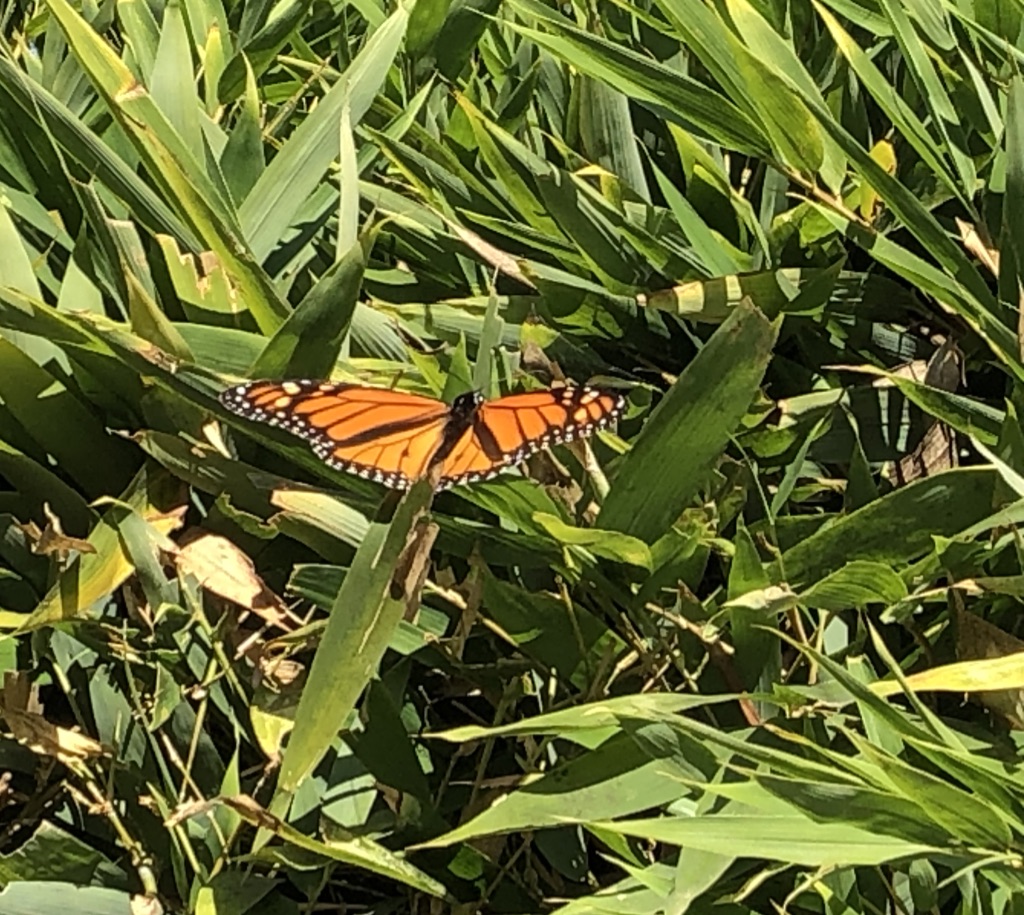
A Monarch butterfly patterns my walk


Peace

I was up early for lab work, not early enough, as three people were ahead of me waiting for the doors to open at 7:00.  Required fasting is an incentive to be out and about. It went easily though and I saw the traffic go from light to a little heavier, and heavier still after I stopped at the store, though I was home by 8:15.

It’s an odd thing, this watching the world and day come to life and light. In summer, it would have been bright, but this time of year, the darkness and the light dance a slow, blended exchange.

I’m reading A Pilgrimage to Eternity by Timothy Egan.  He travels along the Via Francigena, the pilgrim’s trail from Canterbury to Rome.  His motivation is his mother who has passed. He wants to understand her belief in Catholicism even though after birthing seven children, the Church said she shouldn’t have a hysterectomy even though if she didn’t, she would die.  She stood by the Church when the abuse of children by priests was exposed, even when abuse was exposed in their home.  

I’m intrigued with the book because my father was a faithful Catholic.  Of course, he passed in 1969, years before the abuse was exposed, and yet, though his father died when he was young, he only received guidance and support from the priests in the church.

What’s most shocking about the book is the conflicts, wars, crusades, often Christian against Christian, and here we are today, still arguing and fighting, led and misled by those who benefit from division and discord.  

Egan is on this journey because he feels a “malnutrition of the soul”. He says we are spiritual beings, and he’s motivated by the words of Saint Augustine.  “Men go abroad to admire the heights of mountains, the mighty waves of the sea, the broad tides of rivers, the vast compass of the ocean, the circular motion of the stars, and yet they pass over the mystery of themselves without a thought.”

We are entering a sacred time of year.  We gather for the holidays and give thanks. Oh, how long the list when we pause to consider all the gifts.

My grandchild is now one month old, and pronounced “perfect” by his pediatrician.  He’s quite a little being, and my heart floats with the desire that this world he’s now part of can come to the listening, understanding, and compromise that nourishes and nurtures education, communication, and peace.