I've written three books, each a part of my journey to elderhood. Now with this blog my intention is to give a moment to moment accounting of my life as it is now, and now, and now. I'm a leader and student of Sensory Awareness, and a practitioner of Rosen Method. I believe in the connective and collective power of Love.
William Blake wrote, “In seed time learn, in harvest teach, in winter enjoy.”
We are now officially in the season of winter. Where I live, rain is pouring down, and joy, renewal, peace, and ease sprout in the drops linked to connect.
My book group which has been meeting for over thirty years spent Friday night in San Francisco near Union Square. We stay at “our place” which is fully decorated for the Holidays, and entering, we are in France. Downstairs, dinner is served in a castle-like atmosphere honoring Joan of Arc, Jeanne d’Arc. The climax to the meal is Grand Marnier Souffle.
My friend Elaine Chan-Scherer celebrated Winter Solstice at the labyrinth in the Headlands. Her photo captures all we celebrate as we gather to honor All.
Enter into the magic, enchantment, and sacredness of the season
Here we are in the shortest days of the year, and longest if you’re in the southern hemisphere. It’s so exciting, this clear awareness of our planet’s tilt. I tilt inside, a tilt-a-whirl, and yet, there are also a few days where all is still, so I balance there too. The word solstice derives from two Latin words, “sol” meaning sun, and “sistere”, to cause to stand still. Feel the spaciousness in nature’s call and respond. Give yourself time these next few days to stand still.
In checking out two African penguins hatched at the Monterey Bay Aquarium last week, I learn that the aquarium has live web cams so you can view various exhibits wherever you are.
Again, we’re wrapped in fog, and so I imagine the Aquarium is too, and yet, consider all the work on the planet to bring us together to connect land and sea.The penguins are part of a Species Survival plan for endangered species. Birth by birth, we build, and believing in the value, inspiration, and creativity in diversity, receive.
“A human being is a part of the whole called by us universe, a part limited in time and space. He experiences himself, his thoughts and feeling as something separated from the rest, a kind of optical delusion of his consciousness. This delusion is a kind of prison for us, restricting us to our personal desires and to affection for a few persons nearest to us. Our task must be to free ourselves from this prison by widening our circle of compassion to embrace all living creatures and the whole of nature in its beauty.”
It’s raining, all night, and now all day. I love the sound and watching the plants open and renew.
A few years I ago I was at Commonweal and heard Frank Ostaseski speak. I give a taste of that here, but first a few words from his book, The Five Invitations: Discovering What Death Can Teach Us about Living Fully.
“Hope is an optimizing force that moves us and all of life toward harmony. It doesn’t arrive from outside; rather it is an abiding state of being, a hidden wellspring within us. When the mind is still and awake, we can see reality more clearly and recognize it as a living, dynamic process. Hope that is active has an imaginative daring to it, which helps us to realize our unity with all life and find the resourcefulness required to act on its behalf. We can sense the lightness, the buoyancy of this kind of hope, the enthusiasm and positivity it engenders. It energizes us to engage in activities that we imagine will enrich our future. This version of hope is a basic human need.”
I learned about Commonweal years ago when a good friend had cancer. I’ve loved Rachel Naomi Remen’s books for years. Today I quote from an interview with her in the Commonweal newsletter on A Life with Purpose.
She says, “My grandfather believed that each of us has a holy purpose and that we fulfill this purpose in many ways – through our relationships, our families, our careers, or just on some street corner somewhere. We may fulfill our life purpose simply by something we say to some stranger on a bus.”
She continues on speaking of collective purpose which has a Hebrew name, Tikkun Olam, which translates as the word service.
“One of my favorite authors, Kurt Vonnegut, writes about this in his book Cat’s Cradle. According to Vonnegut, God has organized the world into working units called Karasses. A Karass is a group of people who have been born to serve one of God’s holy purposes without ever knowing. Their lives and their work may bear no outward relationship to one another. No matter. They serve their holy purpose together perfectly. Vonnegut says the members of a Karass circle around their holy purpose like electrons circle the nucleus of an atom. Some orbit very close to the nucleus. Others orbit at a great distance. But all are bound to their holy purpose by spiritual bonds, bonds of the soul. Those who orbit very close to the nucleus may be friends or even a married couple. But most others are total strangers: people whose lives and work seems to bear no relationship to one another, people of all ages who speak different languages and have different religions, people who will never meet or have any awareness of one another. Yet their lives fit together in service to their holy purpose. Vonnegut contrasts this to the Grandfaloon, the way human beings organize the world. The people in a Grandfaloon think they are related to one another but actually have no relationship to one another at all; for example, the Yale class of 2003 or any professional sports team anywhere.”
She continues: “According to Vonnegut, should you have the good fortune to meet a member of your Karass, you feel a sort of deep recognition that you can’t explain, a sense of bondedness, a feeling that this other person is truly family.”
Sometimes I think, oh, enough words, as I did this morning, and then I’m invited to peruse my bookshelves and one book calls, and I pull forth Mark Nepo’s Seven Thousand Ways to Listen: Staying Close to What is Sacred, and settle my feet on the floor, my bottom in a chair. What’s here now?
I manage to read a few words and pause with these of Stanley Kunitz: The Universe is a continuous web. Touch it at any point and the whole web quivers.
But then my cat Bella feels I’m clearly not doing anything important and should be petting and kissing her. She is a Calico and when I chose her and her brother almost 14 years ago from a cage at the Humane Society, I was told she would never be affectionate. That is not so. She demands attention, is insistent, and will not be ignored, so I lift her into the chair next to me, and pet and kiss, and notice especially her ears since I was hoping to read a book on listening. I place my lips on her ears and wiggle them back and forth with a kiss. She licks my hands and face.
“The whole web quivers.”
And since a quiver is also a case for holding arrows, I see how the heart is a target aimed and struck.
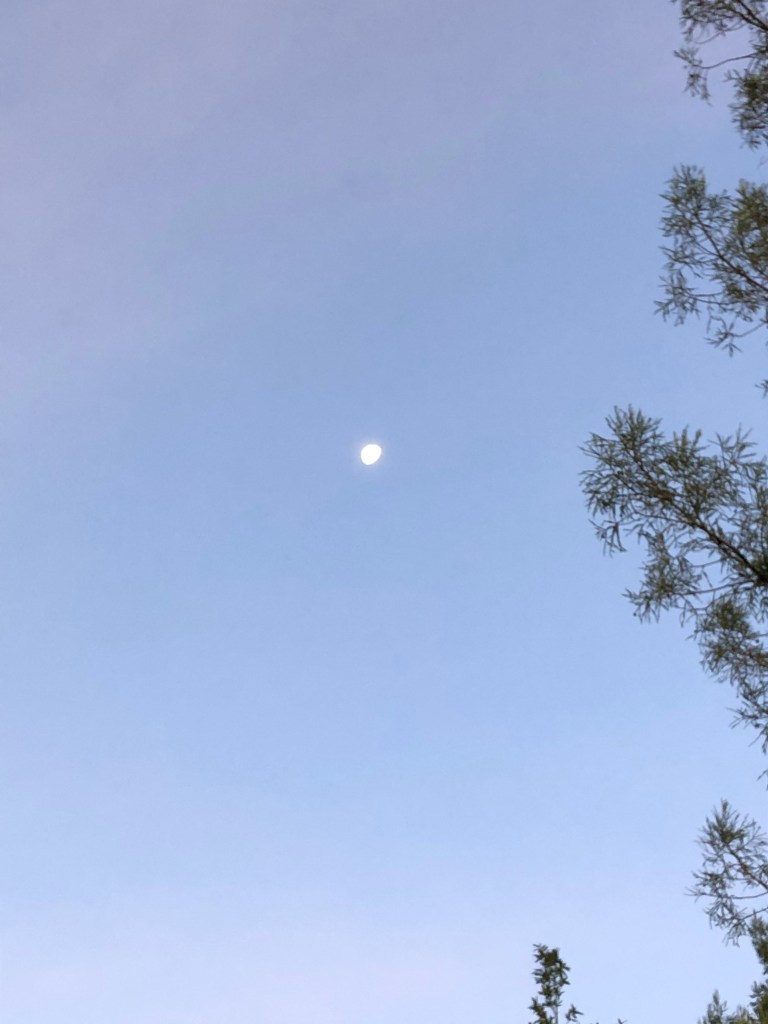
The moon is luminous in the sky this morning. It sips to shrink.
I’m with words from David Whyte:
Apprentice yourself to the curve of your own disappearance.
Can I do that? Apprentice myself to the curve of my own disappearance.
At my age, I understand I won’t live forever. Each moment and breath is precious, a gift, and I desire to be in the pause that knows and honors that, the curve that holds awareness in its lips, a smile.
The moon shows us each month how to grow, shrink, and disappear. She shows us as she stays whole yet gives us a moving view that is teacher and guide.
Moon in the sky this morning, on her way to disappearing
This is the third Sunday of Advent and that has meaning for some. The day is softly coming to light.
I look up the meaning of advent, and come to “coming”. I find myself coming to the word adventure, a place we come to explore and discover. We each have our own way to worship. For me, it’s something deeply inner I’ve always felt and known.
I watch the sun rise and feel that rising in my chest. It’s a new day.
I’m reading The Power of an Open Question by Elizabeth Mattis-Namgyel. She begins the book with her experience of rock-climbing in Colorado. She quickly learns rock-climbing forces her to pay attention. She has to notice “shallow patterns and textures in the rocks”.
She says “Hanging off a rock is an exaggerated experience of facing the unknown.” “When we can’t find a foothold, the mind falls into an open stillness – the same-open stillness we encounter in any situation in which we lose our familiar points. If we have the wherewithal to relax, we find our way.”
Knowing one can’t hang there forever, “we work with our own fear and slowly soften. Now, this is the fascinating part: as we soften, we notice all kinds of new patterns and shapes emerging from the rock. We see places to balance we didn’t see before. We’re not doomed after all. As we soften and open, we access a special intelligence, unimpeded by habitual, reactive mind.”
For me, this time of year allows that. It’s a time to notice and receive.
Softening like wax warmed by flickering flame, I look for new patterns and textures to open and touch like treasure chests.What invites me now?