I’m not feeling well today, so enjoying the sanctity of home, I dip into trees as they’re sliced into paper to anchor words in books. The living trees look into this room, approving this bound way to transform.
I peruse book shelves until one book calls and a page beckons. I look up and a hummingbird flutters by offering nectar to my heart.
I’m feeling peace around my brother’s passing on April 14. As I talk to people, I learn more and more I’m not alone. We bond in the bands that are stretched and expanded, offering horizons beyond what we see or logically know. We loosen what’s caught.
Today, I’m drawn to open W.S. Merwin’s book, “Present Company”. I come to this poem.
To ______________
There is no reason
for me to keep counting
how long it has been
since you were here
alive one morning
as though I were
letting out the string
of a kite one day at a time
over my finger
when there is no string
I sit with that, aware that the tsunami of tears has calmed. Moisture fills my eyes and heart, the moistening connection that never severs, only lengthens and strengthens each breath, no strings attached.
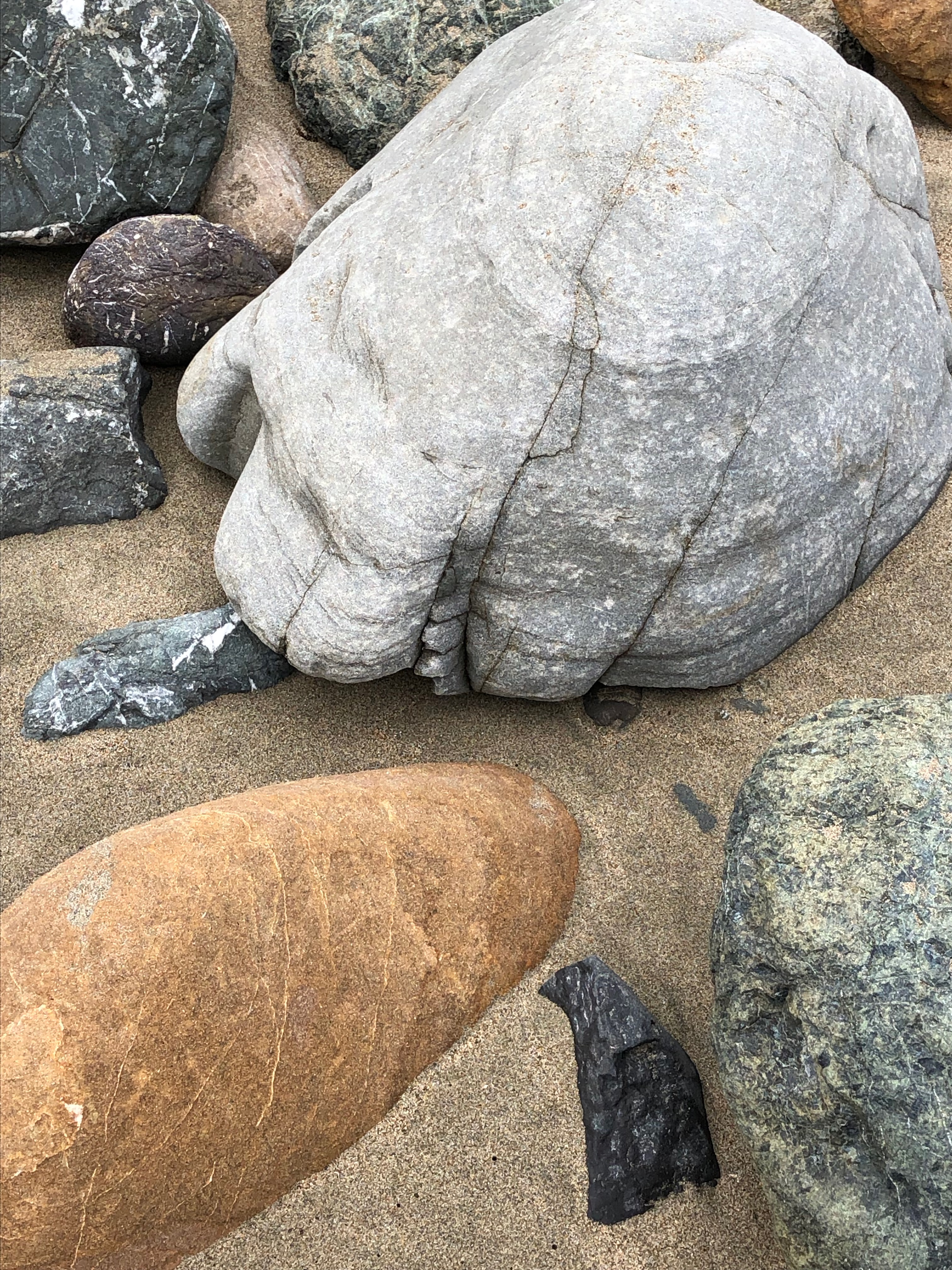
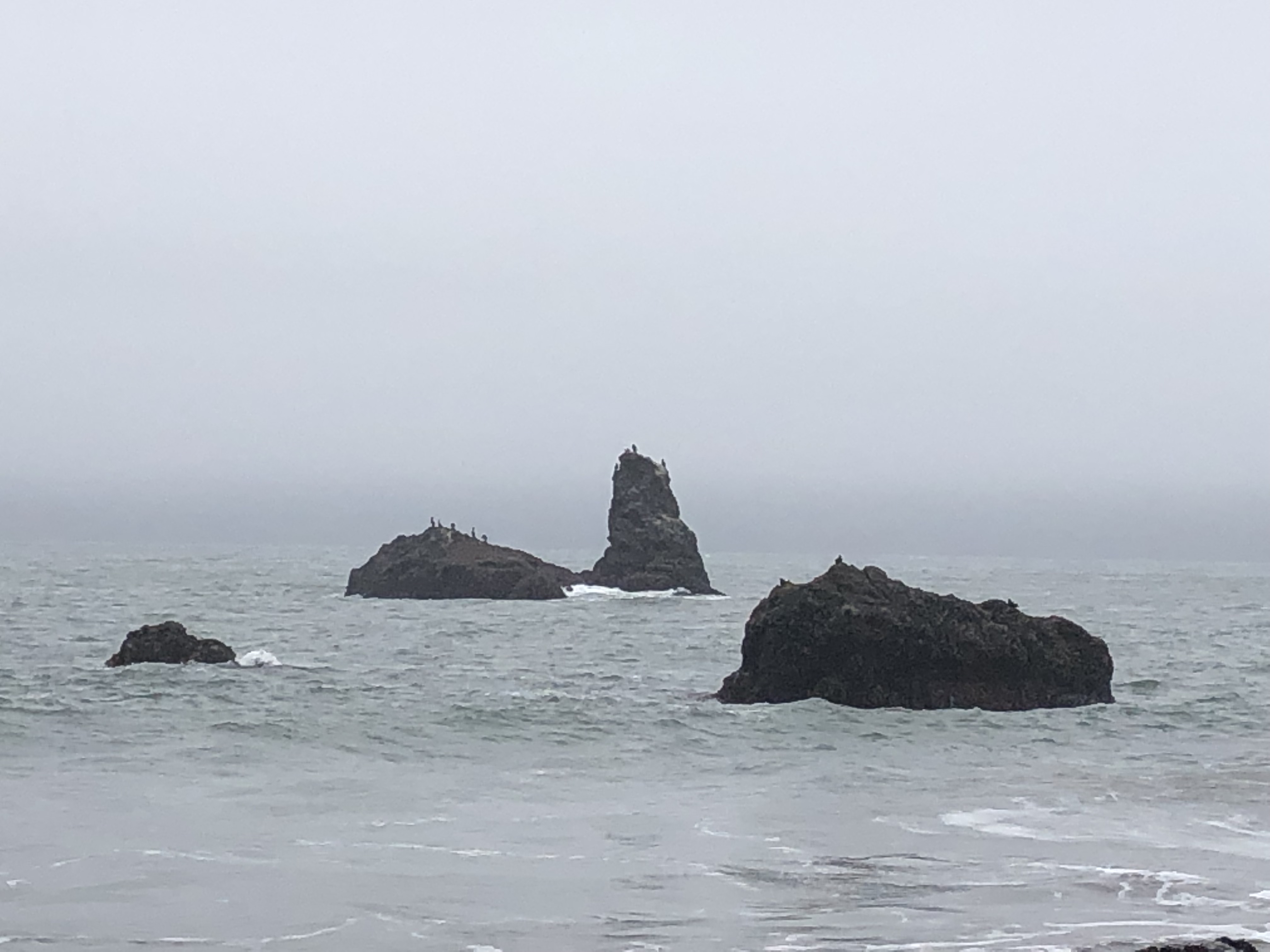
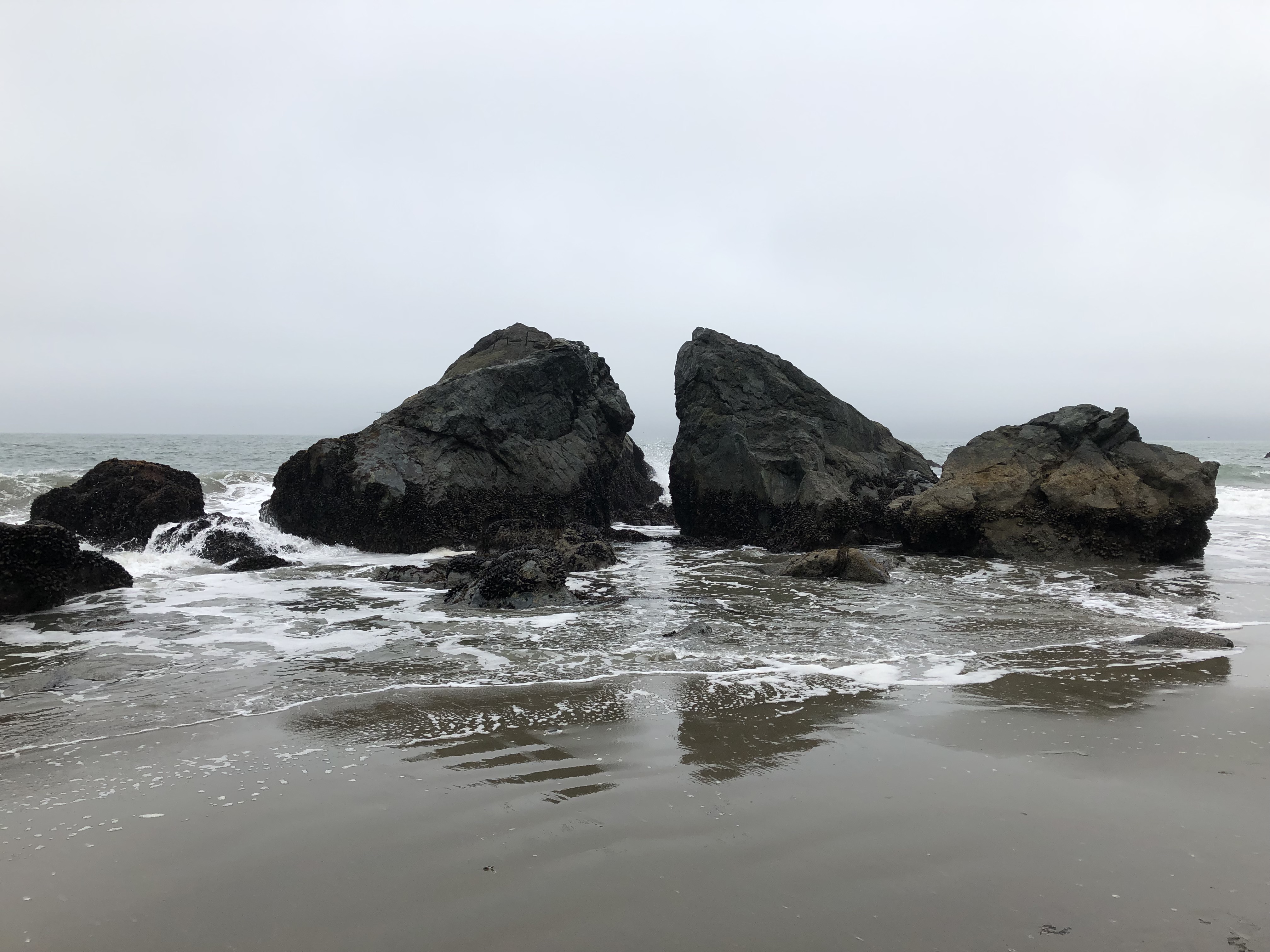
Rocks that form a turtle coming out of a rock-hard shell
This morning I’m with two things, this quote by Toni Morrison: If you want to fly, you have to give up things that weigh you down.
And David Brooks, an opinion columnist in the New York Times writing about Marianne Williamson and how she is the one to beat Trump with her message which is an uprising of decency. Wow!
We’re ripe for change, and yes, a return to decency, ethics, and morality, a return to speaking openly of love and how we’re wired to care.We thrive on connection.
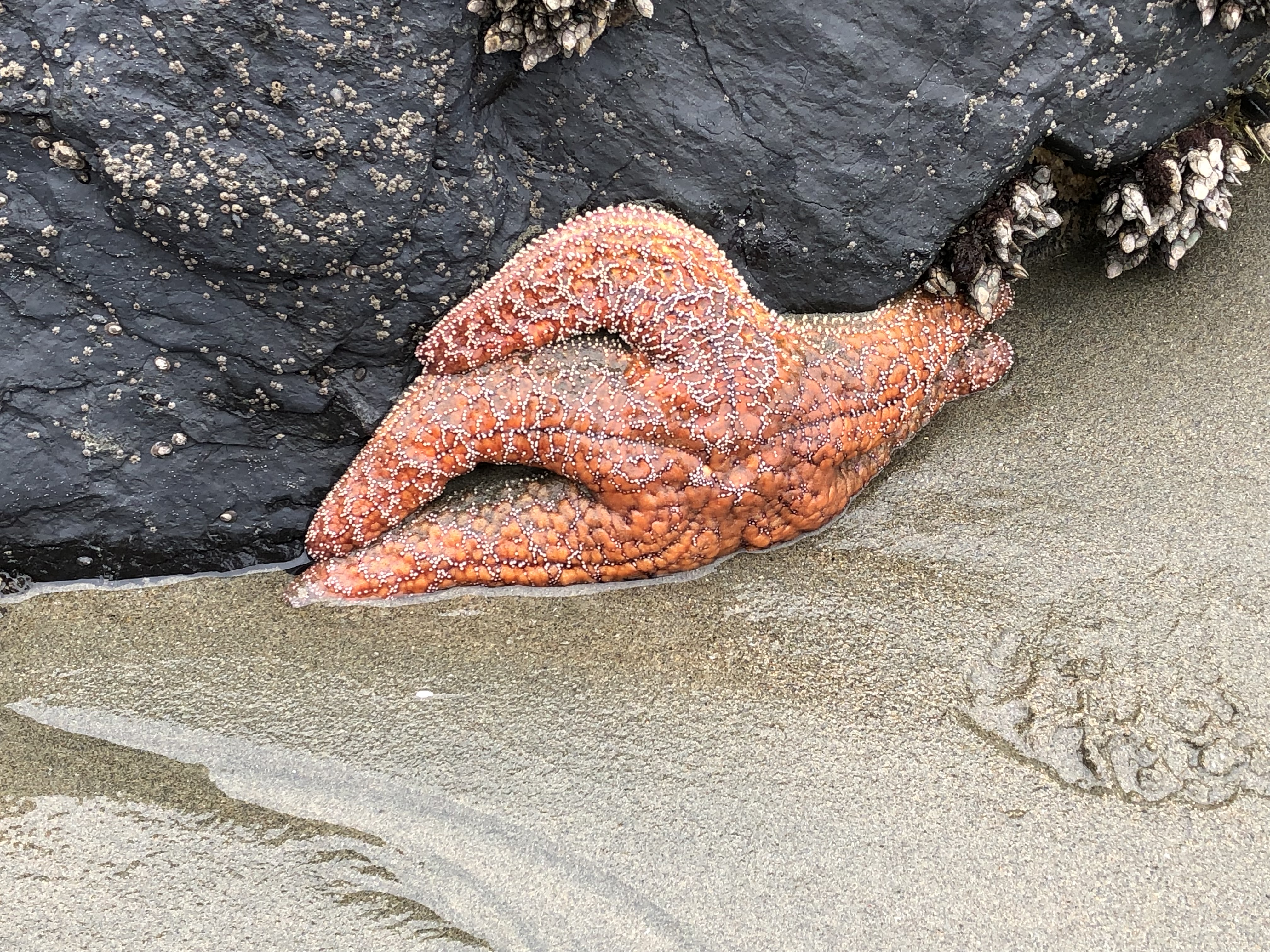
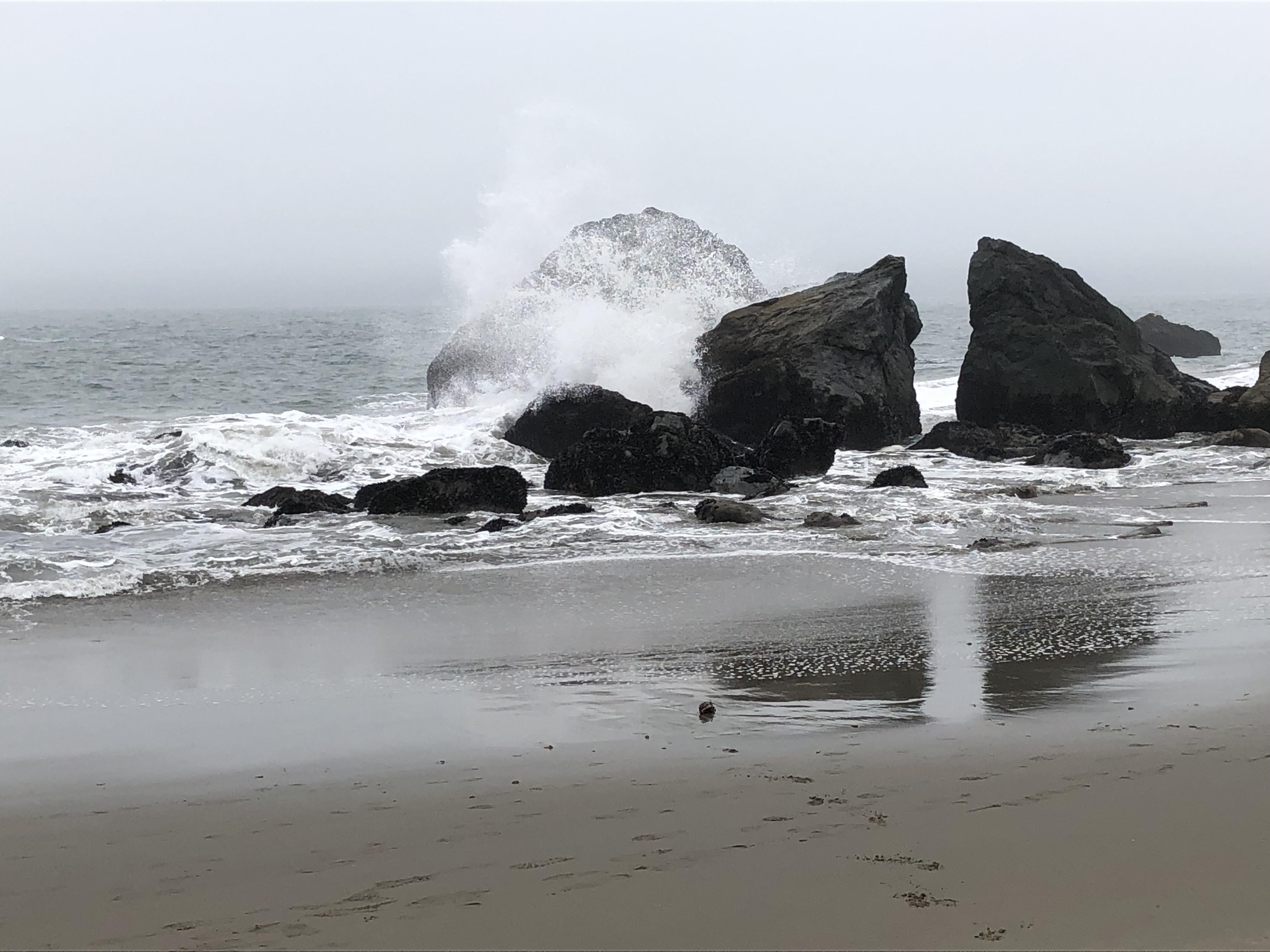
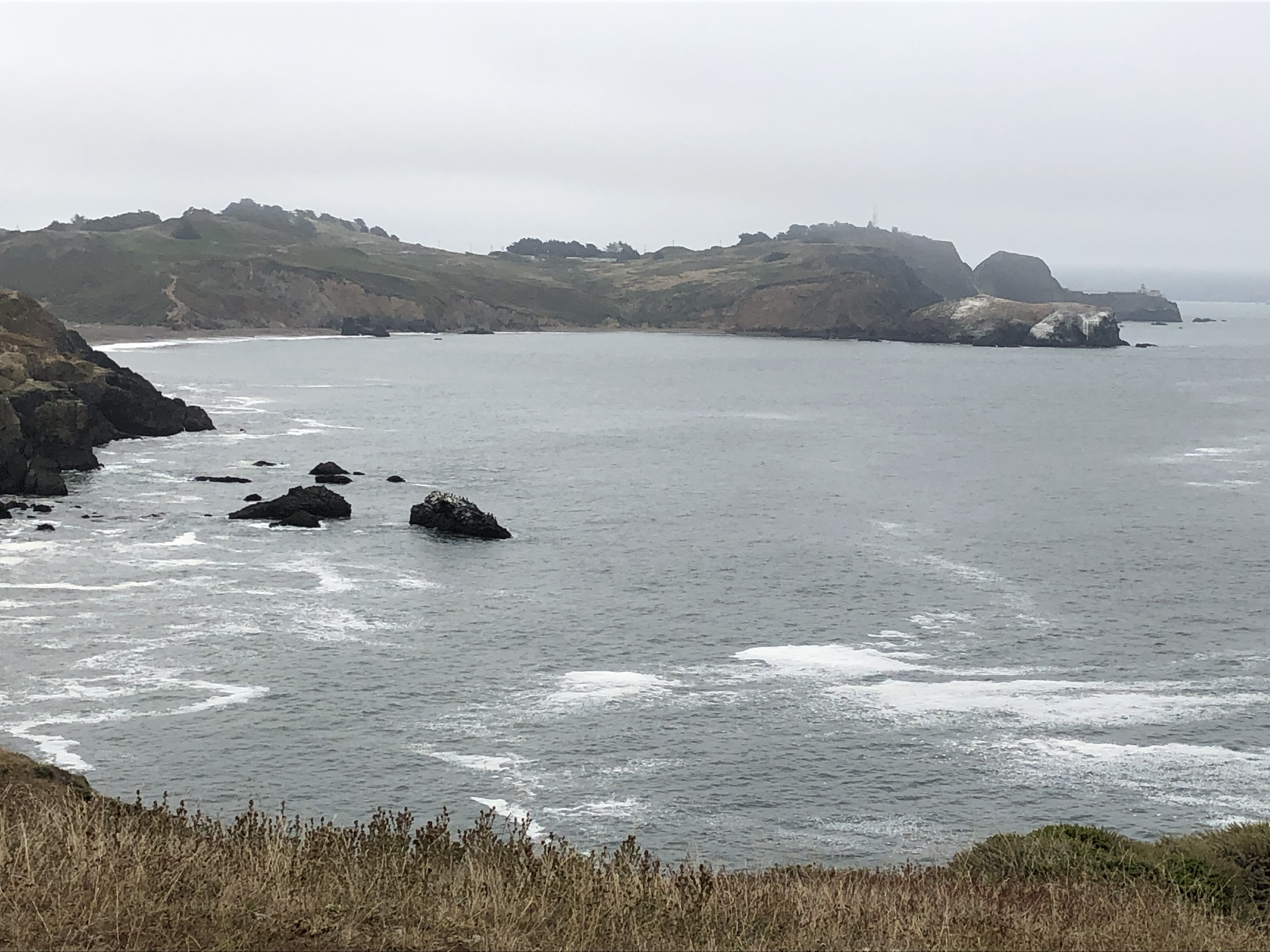
Yesterday, my intention was to spend time with Rodin’s sculptures at the Legion of Honor. Reading about how he worked spirit into clay had me inspired to again visit his work but then the fog around the Legion led me down steps, many steps, to the beach, and rocks that seem like animals held still and a low tide that revealed starfish, or sea stars, as they are otherwise known, and anemone waiting patiently for the return of the sea.
I love the summer fog, its wrap of mystery, mysticism, and mist. It opens dreams.
Yesterday, my Sensory Awareness group, a quartet, met on a Zoom call. We were exploring balance and dizziness by noticing and experimenting with different ways to be with our tongue which leads to examination of all. At one point, Siri joined in, and said, “I can’t help you with that.” How right she is. There are enjoyments and moments only we can create.
As I felt my tongue, allowed it out into the air flickering and tasting like a snake, my breath changed. I felt my tongue like a tail, yes, an augmentation to my balancing act. When I allowed my head to come forward, I felt the muscles around my occiput let go, and sinuses filled with fresh air. My eyes bloomed, and breath came, breath came up from the earth into my feet, up through my heart, and into the air, a shower, an embrace.
Perhaps this sounds silly but maybe today you’ll feel inclined to place a finger on the muscular organ that is your tongue. Maybe a quiver of intention will sharpen your attention as you honor this place the Egyptians called the Rudder of the Soul.
I’m noticing now that when I’m involved in a task, my tongue often comes out to help. It offers ballast and balance.
After this exploration with friend tongue, I went to my local grocery store, Good Earth, and chose three bunches of fresh basil. Unwilling to stifle or stuff them in a bag, I carried them through the store like a bouquet.
Home, I rinsed the leaves, grated Parmigiano-Reggiano cheese, then, garlic, a little salt, and then slowly pouring in olive oil pulsed it all together in the food processor. Presto, pesto!
I felt such gratitude in doing this simple task that I felt compassion for those so burdened with servants that they may never have worked with or prepared their own food, never washed a favorite dish. It’s a balance of course, but Steve and I are living in gratitude these days, each moment, pure grace.
And thanks to easy information access, I learn that the tongue is anchored to the floor of the mouth, and various muscles keep it “suspended” in the throat.
And so, I bring it out to play, and run it back and forth between my teeth, mind in teeth meeting flexibility and strength, the wave that is the tongue.
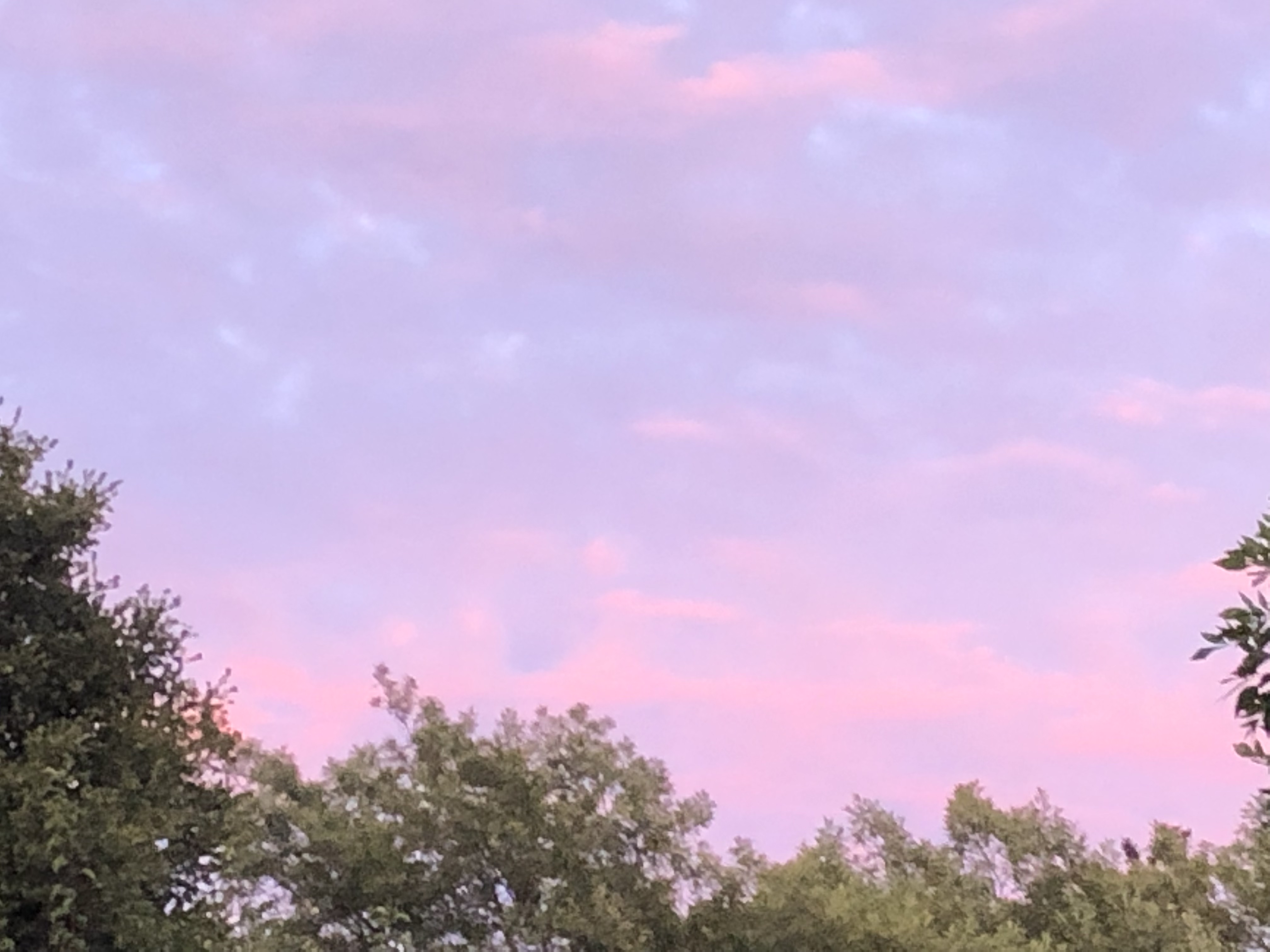
Sunset last night – moon floats off to the right – a rudder for the sky
I’m both fuzzy and clear this morning. My sense is that I’m wrapped in a cocoon and there’s clarity in the cocoon, well, not clarity so much as trust, that this is a momentary resting place where I dismantle, dissolve, and reassemble, honoring presence along the way.
I sit with fear, fear that one could go to a shopping mall and be shot, and I know in truth that something can always happen, so this fear is irrational, and yet it’s there. And I go even further with my scenario. Would I be the one killed, injured, or the one left behind, and what does any of that mean in terms of my living, being, doing, this moment, this day?
I can make myself crazy or I can honor that we never know and so it is to be present, present, present, and in this moment, I’m happily ensconced in a cocoon of some semblance of a body, and some wrapping of a home that’s surrounded by plants I care for as they care for me.
I’m reading Norman Fischer’s book, The World Could Be Otherwise: Imagination and the Bodhisattva Path. I’m in the section on Generosity, the practice of the “perfection” of generosity. We can begin by being generous with ourselves, open to the abundance that is here.
Norman writes, “One of my teachers taught me to practice generosity by taking an object in my left hand and giving it to my right hand. This seemed a bit silly to me, but when I tried it, I detected subtle feelings of gratitude or stinginess, various tiny clenchings of holding back or grasping, and sometimes, the ease of delight and joy. The inner details of actual giving are more complicated than you might think.”
He goes on to say that the practice of self-generosity is not easy, requires “that you care about yourself in the same way you care about others – not more, not less. This is not easy to do.”
I’m struck by this because I came to my teacher of Sensory Awareness through Norman Fischer. I was in a poetry class with him and we weren’t cohering as a group. He requested we stand in a circle and touch the shoulders of the person in front of us. He guided us to mindful touch. We then went outside to the grounds of Green Gulch Zen Center and wrote. When we came back together to read what we’d each written, we sat in a circle and went around the circle reading. What we read was all of a piece. It was as though one person had written the whole. In touching each other, we’d bonded, cohered.
He said if we were interested in what had just occurred, we should sign up for a workshop he’d just taken with one of his teachers, Charlotte Selver, and do it soon because she was very old. At the time, she was 92. She lived to 102, practicing all the way. I signed up for a Sensory Awareness workshop with Charlotte, and was so entranced, I then followed her to a fishing village in Barra de Navidad, Mexico to study with her for a month.
Charlotte liked to work with stones. We’d choose or be given a stone and become attached to it. We might do exactly as Norman says here, practice giving it from one hand to the other, but then the big test came, giving it to someone else. How is it to give the stone, this precious stone, to another?
One time in Barra, the stones were of various sizes, some small, and one so large and heavy I would call it a boulder. One delicate woman went right up to it, hefted it up in her arms and struggled around the room, unwilling or unable to pass it to another, which was the task of this particular experiment. The idea was to know and bond with a stone for awhile and then either willingly or begrudgingly, but certainly with care, give it to another while receiving a different stone in its place.
I’ve never forgotten the symbolism of watching this woman struggle to carry the burden of one huge stone. She held it close to her chest; she couldn’t let it go.
In my book, Airing Out the Fairy Tale, I talk about meeting Charlotte and what her work has meant to me. I find her work well-expressed in these words of Eckhart Tolle.
To bring your attention to a stone, a tree, or an animal does not mean to think about it, but simply to perceive it, to hold it in your awareness.
Something of its essence then transmits itself to you. You can sense how still it is, and in doing so the same stillness arises within you. You sense how deeply it rests in Being – completely at one with what it is and where it is. In realizing this, you can come to a place of deep within yourself.
I went to bed last night with news of one shooting and rose to read of another. I suggest that each of us find a stone and pass it from one hand to another, perhaps find two stones and do this with someone else, passing stones back and forthfor as long as is nourishing for you both.
There are many ways to heal. May today bring the changes we want to see, a unifying knowing we all are one.
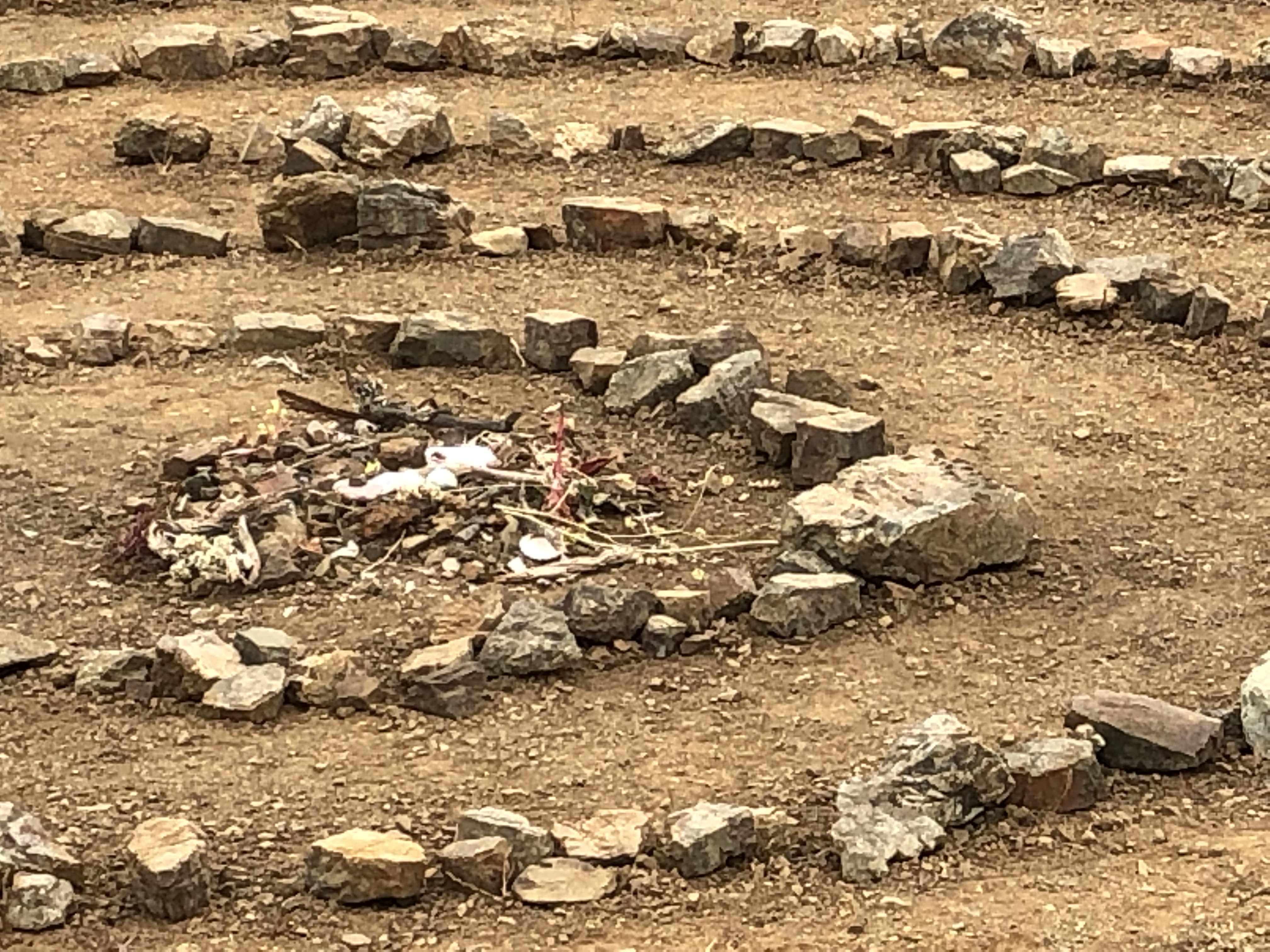
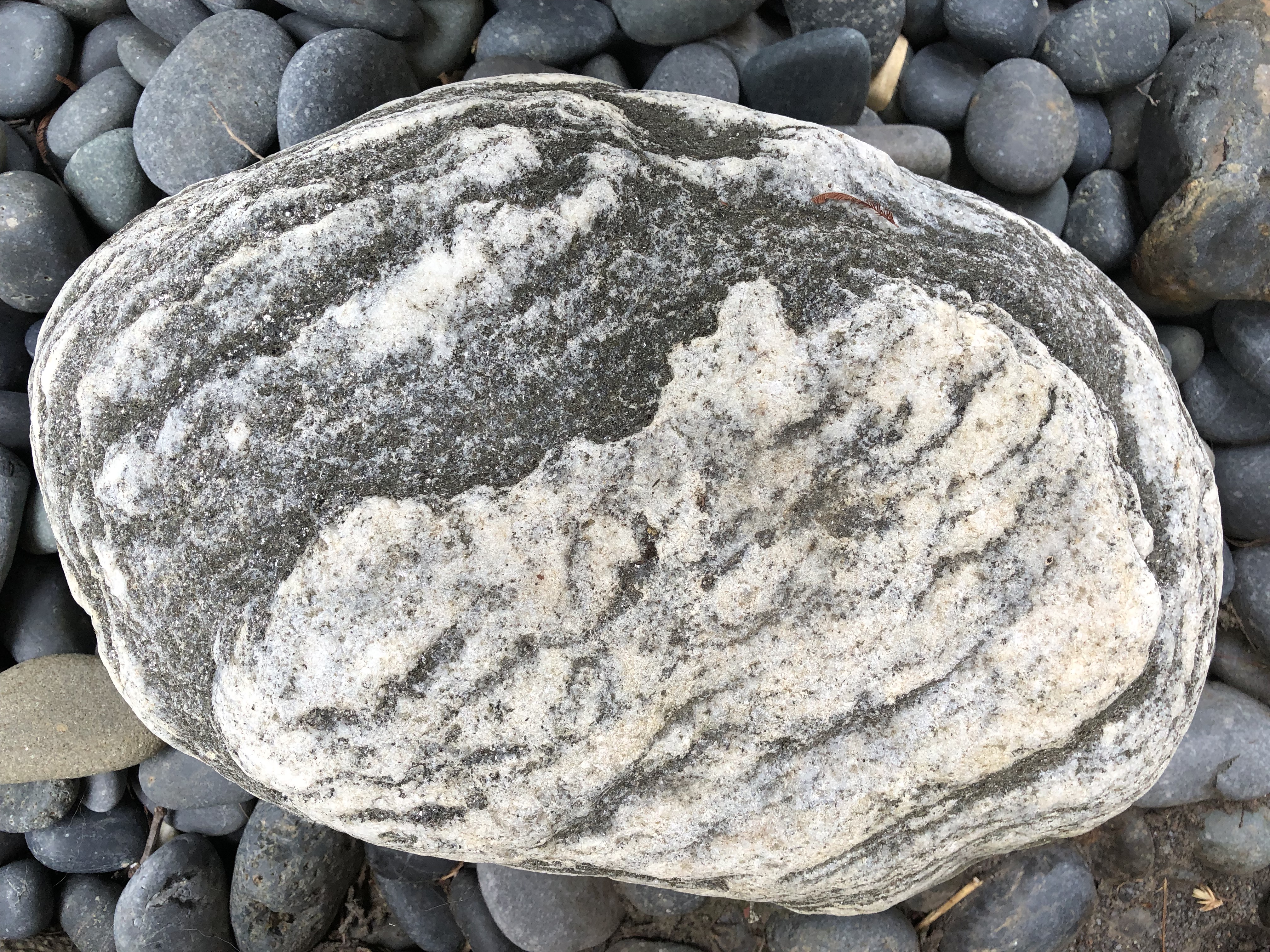
Rock from Monhegan Island, Charlotte’s Summer Home
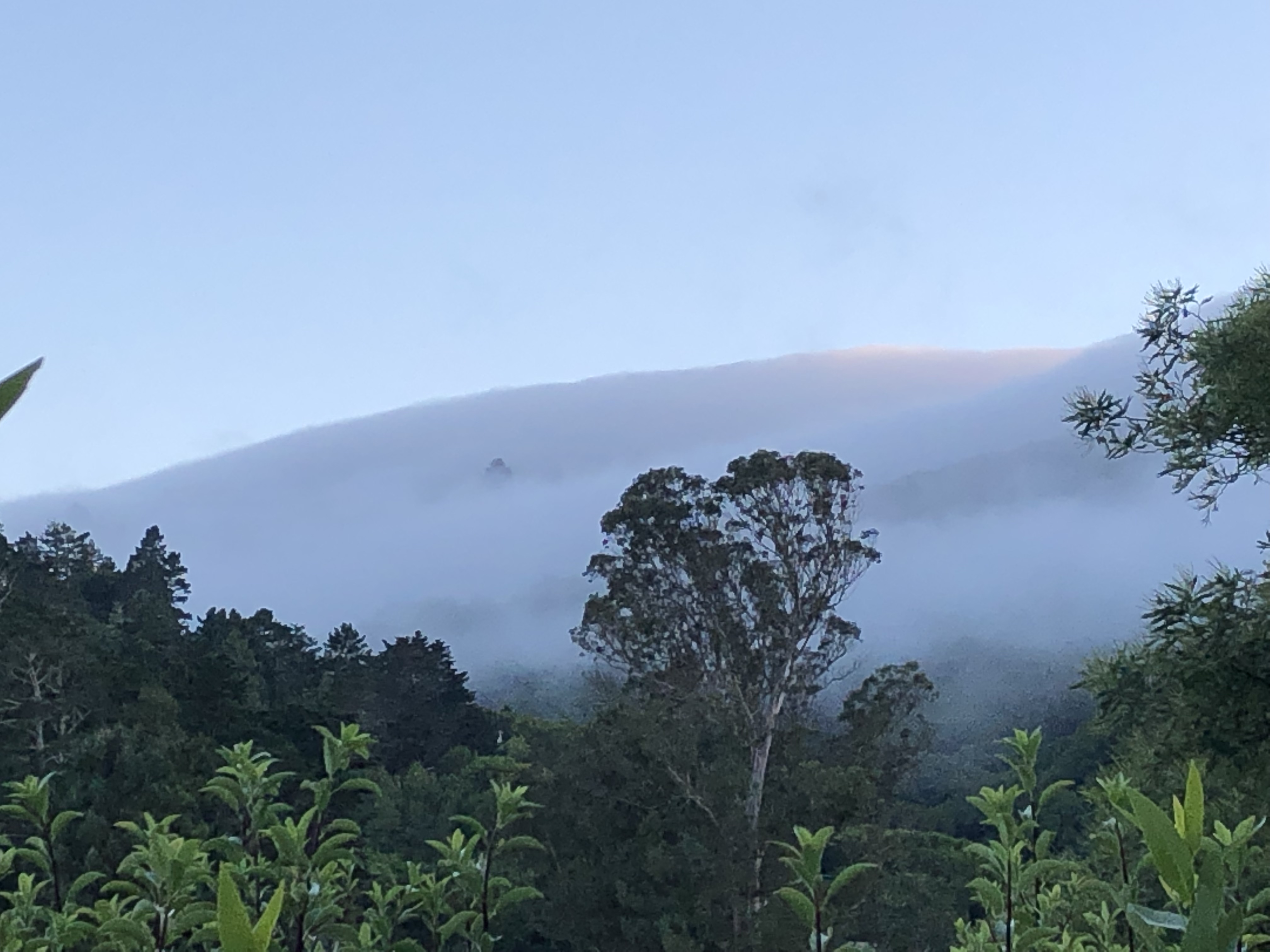
I watch the fog move in and out, sometimes fast, sometimes slow, sometimes wisps, and other times a clasped presence. Sometimes I see it moving but it doesn’t advance. It dissipates, unseen.
As I watch the fog, I read from The Hidden Lamp, learn that in Chinese lore it is said that the chicken listens with her heart to hatch her eggs.
Yesterday I shared an Emily Dickinson Poem, “I Felt a Funeral in my Brain”.
I had listened to Billy Collins and Marie Howe discuss the ambiguity of the poem, the nuance, and multiple meanings.
A friend questioned the last line concerned because it ended with a dash. Had I forgotten to post the whole poem? Well, that’s Emily; she loved her dashes.
Researching the poem further, I now learn that not all editions include this last stanza, but, for me, it’s the most important of all.
And then a Plank in Reason, broke,
And I dropped down, and down –
And hit a World, at every plunge,
And Finished knowing – then –
Why do I and others find this poem important? In living, we play with the ground, with the responding aliveness and lift from the pull of gravity. We’re in a dance, and yet, for many of us, when we start to question our “existence”, there comes an awareness of the space between the molecules. Where is our support? We’re mainly air.
Her “then” and dash open up this dance of connection and exchange. We don’t know what she “Finished knowing”, but we know that she wrote and examined and explored her inner world and she did her domestic tasks. Her inner world was vastand she “went downstairs and made cookies”, as Collins and Howe put it.
This poem reminds me of the work of Morihei Ueshiba, the founder of Aikido. He said we’re always coming back to balance. Think of walking. Unless we shuffle, there’s great courage in allowing one foot to leave the ground, explore the air, and come back down. We may do it thoughtlessly, unconsciously, but when slowed down and analyzed, we can see it is a big deal to take a step.
For her, a “plank in reason” broke, and she fell down, down, down. Did she fall down into her own knowing, essence, and strength as she explored world after world?Did her “fall” take her further downward or bring her out? She leaves the poem open for our own exploration, for us to figure out.
I prefer to believe that she fulfilled what Morihei Ueshiba spoke of when he said:
“Iron is full of impurities that weaken it; through forging, by exposure to heat, cold and hammering, the impurities are forced out and the ironis transformed into razor-sharp steel. Human beings develop in the samefashion.”
I think Emily Dickinson used poetry as a way to forge, hammer, examine, and transform, and that is why she leaves the poem with a simple word and a dash – next –
And with that the breath moves in and out like summer fog on a ridge.
It’s Bay area cool where I live so I’m curious about where the term “dog days of summer” originated. I thought it might have to do with days where we lengthen our tongues into ice cream scoops.
Now I learn that in the summer, Sirius, the brightest star visible from any part of Earth and part of the constellation, Canis Major, the Greater Dog, rises and sets with the sun. The term refers to the 20 days before and the 20 days after the alignment of Sirius with the Sun – July 3 to August 11 – so we’re in the dog days of summer, and because dogs wisely lie down and reflect, I’m in contemplative mode.
My mother was raised Christian Science and she simplified it for me to “All is Love”. That philosophy has served me well. Therefore I’m puzzled these days because lately there seems to be a great deal of humor and angst about whether the word “love” is appropriate in political discussion.
Mahatma Gandhi used nonviolent resistance to free India from the ruling domination of the British. I’m sure at the time it seemed futile, but as Margaret Mead is said to have said, Never doubt that a small group of thoughtful, committed citizens can change the world: indeed, it’s the only thing that ever has.
For me, that commitment is the love of which my mother spoke.
The star Sirius, though white to blue-white in color, radiates in our sky with many colors. She, and somehow I see her as a she, can be seen as a rainbow star, a twinkling composite signaling change.
Bella loves to rest in curves – no straight lines for her
I’m enjoying a Master Class with the marvelous poet Billy Collins. He comes to me in my very own room.
Today I watched Collins and Marie Howe, another amazing poet, discuss a poem by Emily Dickinson, “I Felt a Funeral in My Brain”.
I’m sure I’ve read this poem before but I never took it in as I did today. I think I was more deeply affected because yesterday I read of the suicide of a 22 year old woman. She had been dealing with depression and the weight of it became too much.
Can a poem save a life? I want to believe so. Could this poem have helped her know that Emily Dickinson made it through, and she might too?
I thought that August is a month with no set holidays and therefore it’s meant to be celebrated jubilantly and spaciously each of its 31 days. Then, this morning I read that today is Ice Cream Sandwich Day, International Beer Day, and National Coloring Book Day. Tomorrow is Watermelon Day.
What is this human need to name and categorize?
Yesterday my son introduced me to Catherine Ingram and her article on “Facing Extinction”. Okay, that isn’t the most inviting way to begin a day that celebrates ice cream sandwiches, beer, and coloring books, but she moves through categories, essential categories and comes to Love, the binding fabric we share.
Jonathan Franzen, winner of the National Book Award and many other literary honors, writes in his latest book The End of the End of the Earth: “Even in a world of dying, new loves continue to be born.” This is now the time to give yourself over to what you love, perhaps in new and deeper ways. Your family and friends, your animal friends, the plants around you, even if that means just the little sprouts that push their way through the sidewalk in your city, the feeling of a breeze on your skin, the taste of food, the refreshment of water, or the thousands of little things that make up your world and which are your own unique treasures and pleasures. Make your moments sparkle within the experience of your own senses, and direct your attention to anything that gladdens your heart. Live your bucket list now.
And she concludes with words of Leonard Cohen:
“It is in love that we are made; in love we disappear.”
There are a great many of us sharing the planet today. In 1952, there were 2.6 billion people on the planet. Now, there are 7.7 billion.
I was born in Chicago, Illinois in 1949 though we moved to Ames, Iowa when I was six weeks old. Now I live in the San Francisco bay area. No wonder I often feel overwhelmed with the numbers of people, the crowds. I like solitude and nourishing on, and in, my own space.
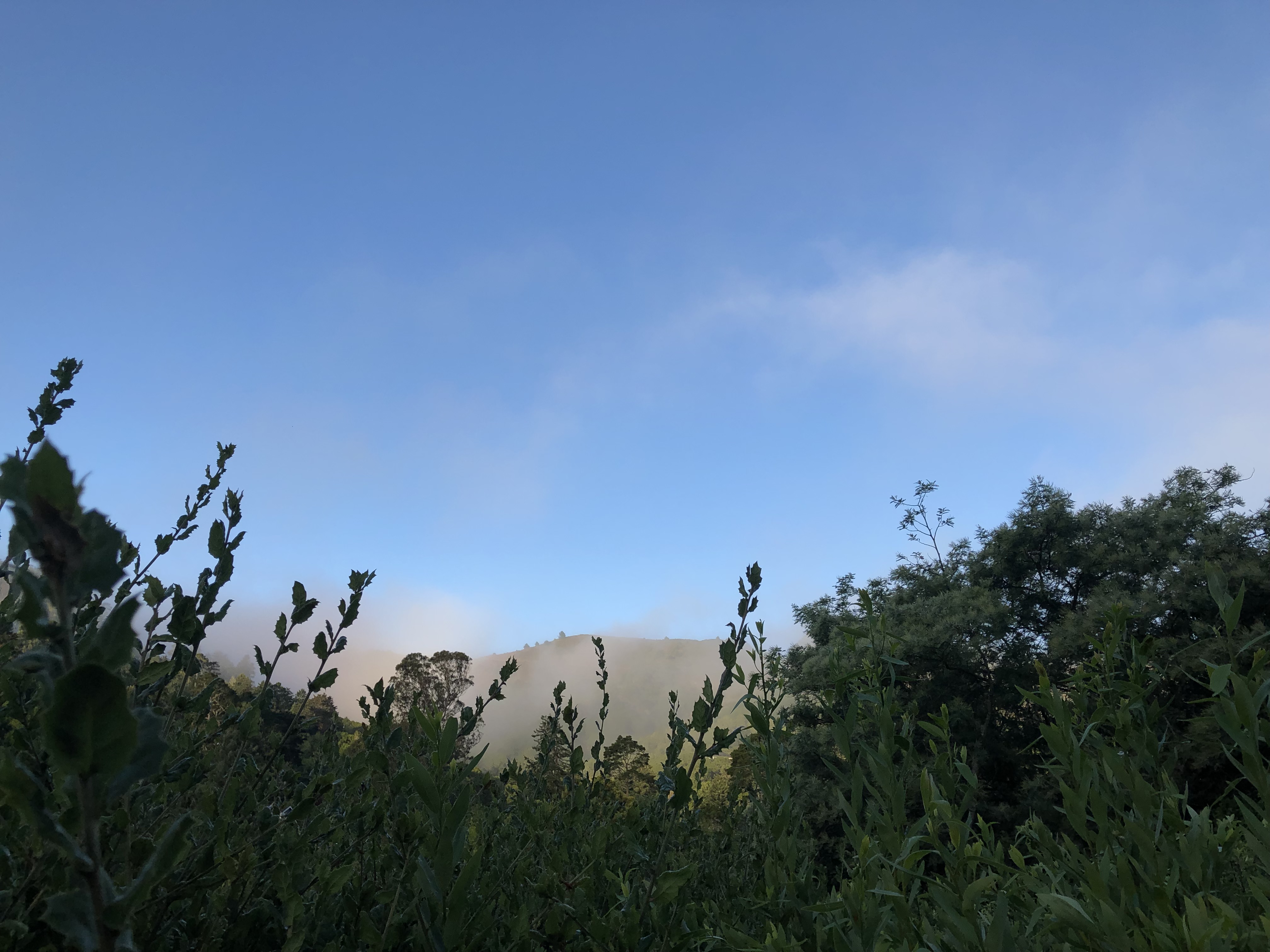
Today as I look out, fog moves in to cloak blue sky and I pull into the flow of my blood, the marrow in muscles doing tiny push-ups and sit-ups of their own. I am an ecosystem. My lungs branch and reflect the branches of the trees which now lean in close since most of what I see is gray, but now wait, a lighter gray and further trees reveal, and I choose now where to place my visionary plate.

 Cathy's Blog!