After I posted about Art, I came to my friend Mirka’s blog. Savor and consider what Art means to you. How does it augment your life?
Art
The fog rolled in last night. That should help with fighting fires and dampening down the smoke. Yesterday I had errands to do, just two, but that little time outside allowed the smoke to affect my heart and lungs. I could feel it, perhaps exasperated by the lies coming from the RNC.
I try to understand. I want to understand but I’m flabbergasted.
Ruth Asawa worked to bring art into the schools. She knew what it meant to have artists teaching her when she was young. We share our gifts. Perhaps that sharing was part of her resilience and untiring energy to feed, help, and inspire others.
Perhaps it’s for each of us to create art each day, to draw flowers in our hearts, and sprinkle nosegays in our lungs. It is to know the world is beautiful with or without smoke.
We are being tested in a variety of ways and it is to see how creativity and imagination can spark and soothe, open and connect the patterns and relationships in each day.
Here’s a taste of Ruth. “Bucky” is Buckminster Fuller.
Angels in Our Midst
Today two men delivered our washing machine, one Hispanic and one Black, both young. Our old washer had served faithfully for 25 years but after two repairs in the last month with another problem exposed, we decided to move along.
When I said to the Black man who was installing it that this one would last our lifetime as we were “old”, he said, “not old; the Soul is young.” He went on to speak of what his father and grandfather said about life being a blessing and we’re here to learn and then we move on. I felt blessed as I sat distanced from him and listened as though I were in a temple, mosque, or church, which is interesting because since we cleaned out our garage, and I bought new rugs for the entry, and plan to hang some paintings, each time I go in and out, I feel it as sacred, and say to myself, “Holy, Holy, Holy”. The words come rising up from belly and heart because yes, all is Holy and we live amidst the Angels, right here, right now, so stroke the Angel in you, so blessed to be alive and caressed.
The word of the day, for me, has moved, though still embraced, from resilience to connection to empathy. Michelle Obama spoke of empathy in her speech at the DNC, and I’m hearing it over and over. Have empathy for ourselves, and all that’s here in this world we share.
We’re still encased in smoke, and today I read to video all the rooms in our home, video all we have. What I see in all of this is how much I value what is here, all I’ve collected and been given, and what matters is the people and animals in my life. I may have to walk away from it all, and in many ways, that’s always true.
I open a journal of quotes from Charlotte Selver, my first teacher of Sensory Awareness.
“Is it possible that we could feel more deeply and fully what we happen to do at the moment, and allow our fuller contact with it? So that not the past and not the future and not the anger about what happened two minutes ago or ten years ago stands in our way and holds us back – but we are all there for what is now.”
And yet I reach back for photos as today the sky is gray with smoke and ash.
The Line
Cooling breezes blew in yesterday and in this moment, where I live, all is calm. We’re told another storm comes which could bring lightning leading to more fires. It’s been unsettling, and yet, I’m reading Marilyn Chase’s book, Everything She Touched. It’s about Ruth Asawa, an amazing sculptor and woman. Seeing her work at the De Young in San Francisco I’ve been enchanted, but now I know more of what created this woman and her art.
When Pearl Harbor was bombed, her parents, farmers in the U.S. but immigrants from Japan, were separated. Her father was taken away and interrogated as a spy. The other members of the family were taken from CA and interned at the Rohwer Relocation Center in Arkansas.
Ruth’s response: “I hold no hostilities for what happened; I blame no one. Sometimes good comes through adversity. I would not be who I am today had it not been for the internment, and I like who I am.”
She had an amazing array of teachers but what most stays with me is that she used wire for her sculptures. When one considers how she was confined by barbed wire that surrounded the concentration camp, and how she then turned it into art, well, to use a cliche, she turned lemons into lemonade.
She learned the wire-crocheting technique she used while on a field trip in Toluca, Mexico, where villagers used a similar technique to make baskets from galvanized wire. She said:
“I was interested in it because of the economy of a line, making something in space, enclosing it without blocking it out. It’s still transparent. I realized that if I was going to make these forms, which interlock and interweave, it can only be done with a line because a line can go anywhere.”
“A line can go anywhere.”
I’m reminded of Annie Dillard’s words from her book The Writing Life. She’s writing about a stunt pilot Dave Rahm who died during a performance.
The air show announcer hushed. He had been squawking all day, and now he quit. The crowd stilled. Even the children watched dumbstruck as the slow, black biplane buzzed its way around the air. Rahm made beauty with his whole body; it was pure pattern, and you could watch it happen. The plane moved every way a line can move, and it controlled three dimensions, so the line carved massive and subtle slits in the air like sculptures. The plane looped the loop, seeming to arch its back like a gymnast; it stalled, dropped, and spun out of it climbing; it spiraled and knifed west on one side’s wings and back east on another; it turned cartwheels, which must be physically impossible; it played with its own line like a cat with yarn. How did the pilot know where in the air he was? If he got lost, the ground would swat him.
Rahm did everything his plane could do: tailspins, four-point rolls, flat spins, figure 8’s, snap rolls, and hammerheads. He did pirouettes on the plane’s tail. The other pilots could do these stunts, too, skillfully, one at a time. But Rahm used the plane inexhaustibly, like a brush marking thin air.
His was pure energy and naked spirit. I have thought about it for years. Rahm’s line unrolled in time. Like music, it split the bulging rim of the future along its seam. It pried out the present. We watchers waited for the split-second curve of beauty in the present to reveal itself. The human pilot, Dave Rahm, worked in the cockpit right at the plane’s nose; his very body tore into the future for us and reeled it down upon us like a curling peel.
Like any fine artist, he controlled the tension of the audience’s longing. You desired, unwittingly, a certain kind of roll or climb, or a return to a certain portion of the air, and he fulfilled your hope slantingly, like a poet, or evaded it until you thought you would burst, and then fulfilled it surprisingly, so you gasped and cried out.
The oddest, most exhilarating and exhausting thing was this: he never quit. The music had no periods, no rests or endings; the poetry’s beautiful sentence never ended; the line had no finish; the sculptured forms piled overhead, one into another without surcease. Who could breathe, in a world where rhythm itself had no periods?
She continues:
“Purity does not lie in separation from but in deeper penetration into the universe,” Teilhard de Chardin wrote. It is hard to imagine a deeper penetration into the universe than Rahm’s last dive in his plane, or than his inexpressible wordless selfless line’s inscribing the air and dissolving. Any other art may be permanent. I cannot recall one Rahm sequence. He improvised. If Christo wraps a building or dyes a harbor, we join his poignant and fierce awareness that the work will be gone in days. Rahm’s plane shed a ribbon in space, a ribbon whose end unraveled in memory while its beginning unfurled as surprise. He may have acknowledged that what he did could be called art, but it would have been, I think, only in the common misusage, which holds art to be the last extreme of skill. Rahm rode the point of the line to the possible; he discovered it and wound it down to show. He made his dazzling probe on the run. “The world is filled, and filled with the Absolute,” Teilhard de Chardin wrote. “To see this is to be made free.”
The Soil Sponge
My friend Terry is currently evacuated from her home in Loma Mar. Another is evacuated from her home in Guerneville. What can be done?
Terry works with the microorganisms in the soil. Years ago, she was on a Vision Quest and the message she received was that her work is to speak for those who don’t have voices we understand. She’s been doing that ever since.
This morning she tells me to Google Walter Jenhe so I do. I share a three minute taste of him and his message which moves into a two hour one. I’m only part-way through that.
Terry says: Our job as humans is to understand the systems that make the earth habitable. A big one is the water cycle. The water cycle is created and kept in balance by plants and the microbial community supporting the plants. The microbial community is part of the plants digestive and immune system. Just like us. Cutting the forest turns us to desertification which means worse conditions for life on earth. We have ignored the services the natural world provides. We need to understand and work with it. The earth needs healing from our neglect and it can be done. We just need to trust, educate and support.
This is a labor of love for humanity. Much better than war. Let’s put all our resources towards rebuilding and maintaining a natural ecosystem. We are one with nature.
On day 27 of my time with Adyashanti, I’m advised to seek to understand before I seek to be understood.
Today I listen to the earth, the earth within, and the earth on which I live. I seek to understand.
Inspiration
I spent yesterday with my grandson. Enchanted, I simply watch and interact as his almost ten month old self continues to discover and manipulate the world. As I drove down to his home, there was smoke the whole way and yet a little pocket of clear air where he lives so we were outside exploring together.
I listen to the speeches from yesterday, inspired.
This morning I listen to the governor of New Mexico Michelle Lujan Grisham. I’m grateful for how powerfully she brings the issue of climate change and the essential importance of caring for our planet into the convention.
Here she is:
Art
Why do we make art? What opens in us?
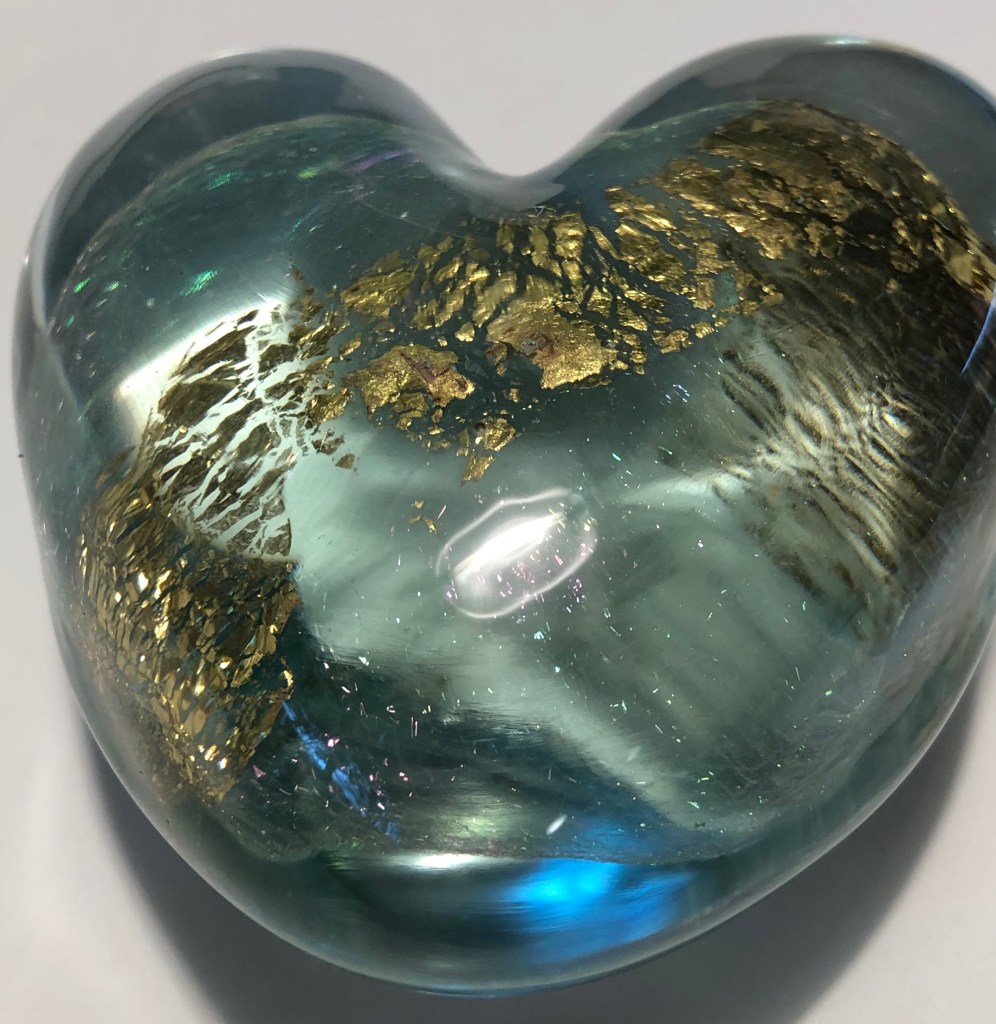
Years ago, I painted my heart on silk. I couldn’t stop. I cut some into hearts, pocket hearts, and framed others in hoops and covered the walls. Recently I let most of them go as I felt it’s important to live and show my heart, the real beat of what pumps my living in and out.
Yesterday I was going through images of my grandson, now almost ten months old. I saw his heart beating on the sonogram as he was still in the womb. My heart pumped in rhythm to his, resonant as he was enclosed in the beat of another. Perhaps we always are when we pause to feel how we’re held.
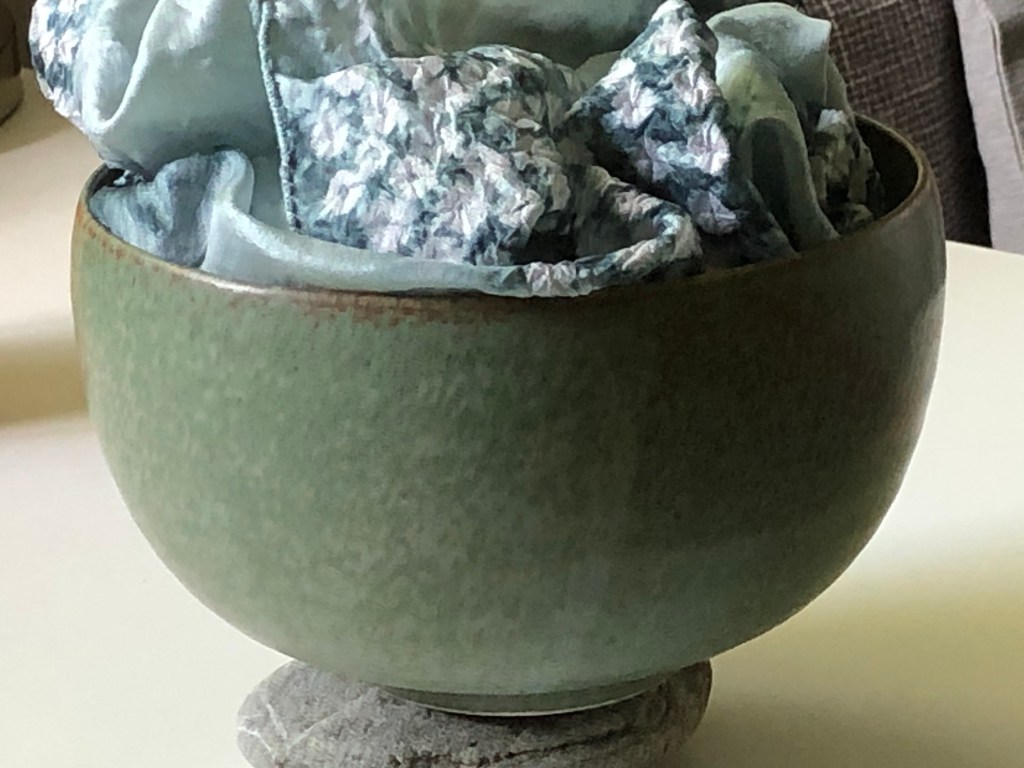
That morning I participated in a Sensory Awareness workshop on Zoom, each of us in our own homes where Michael Atkinson had asked us to gather and come with three objects, a scarf or bandana, a rock we could hold in our hand, and a bowl or vase.
First, we lined our three objects up, and then, we worked with them as he offered invitations. I could feel when my objects were just right in that moment, representative of how I felt. They were in the womb of the beat of my heart.
At first I placed the rock in the bowl, and wrapped the scarf around it. I felt how all was embraced, embraced in my heart.
Then we hid one object. I was surprised when I set the bowl on the rock and it stayed, balanced on what did not appear to be a flat surface.
I placed the scarf inside.
All of it was Art, each moment, Art!
Truth
When I came to Rosen Method Bodywork, I learned that the body doesn’t lie. That was such a relief to me. Breath flowed through the truth of that. There’s nowhere to hide, no need.
Of course, there may be layers sitting on top of that truth which is why we study the breath, the bridge between the conscious and the unconscious.
On day 24 of my 30 day study with Adyashanti, he speaks of telling the truth and how that opens up new pathways of reception leading to awakening. The most important piece is to tell the truth to ourselves, to listen to our own truth. We open the senses and listen within. The organism is intelligent. Tune in!
I woke this morning thinking about corners, corners in my home, corners in myself. Is a corner a place where energy is stuck or a place where walls meet to make a whole, to create this enclosure in which I live? What dwells there?
The air is hazy with smoke this morning. Because there are so many wildfires in the Bay area right now, they’ve stopped naming each one. Three separate areas have fires named “Lightning Complex.” I walk outside. There’s ash on the tables. I think of all that’s burning up right now, imagining the phoenix that rises with each breath, each day.
I appreciate the Democrats and what they’re bringing together at the convention this week. It’s essential. One thing I note that I haven’t heard mentioned is the subject of climate change, and maybe that’s because it’s obvious. In the past, October was a dangerous fire month where I live. Now, we are in August and I have an evacuation bag packed, and two carriers for our kitties in case there is enough warning to get into our car and drive somewhere else. Other times of the year, we deal with the rising tides, and whether the roads that lead to the freeway will be underwater as each year the tides become more of an issue.
All of this is to say it’s essential to stay awake to change even as we soar in gratitude for all that’s here and for the confluence that’s the Democratic party right now.
Now I’ll listen to Adya’s Day 25: Energetically Leading with the Heart.
Courage and Sacrifice
When I rise at 5 these days, it’s still dark. But it’s a gentle dark unlike what’s happening right now, and yet the voices at the Democratic convention. Yes. There’s community, coherence, compromise, integrity, intelligence, reality, and light.
I’m with the words of Michelle Obama. “But let’s be clear, going high does not mean putting on a smile and saying nice things when confronted by viciousness and cruelty. Going high means taking the harder path. It means scraping and clawing our way to that mountaintop. Going high means standing fierce against hatred while remembering that we are one nation under God, and if we want to survive, we’ve got to find a way to live together and work together across our differences. And going high means unlocking the shackles of lies and mistrust with the only thing that can truly set us free: the cold hard truth.”
Wow!
This comes from Writer’s Almanac today.
On this date 100 years ago, the 19th Amendment to the Constitution was ratified. It stated that”The right of citizens of the United States to vote shall not be denied or abridged by the United States or by any State on account of sex.”
The first national constitutional amendment had been proposed in Congress in 1878, and in every Congress session after that. Finally, in 1919, it narrowly passed both houses of Congress and was sent to the states to be ratified. Most Southern states opposed the amendment, and on August 18, 1920, it all came down to Tennessee. The pro-amendment faction wore yellow roses in their lapels, and the “anti” faction wore red American Beauty roses. It was a close battle and the state legislature was tied 48 to 48. The decision came down to one vote: that of 24-year-old Harry Burn, the youngest state legislator. He had been expected to vote against it, but he had in his pocket a note from his mother, which read: “Dear Son: Hurrah, and vote for suffrage! Don’t keep them in doubt. I noticed some of the speeches against. They were bitter. I have been watching to see how you stood, but have not noticed anything yet. Don’t forget to be a good boy and help Mrs. Catt put the ‘rat’ in ratification. Your Mother.” He voted in favor of the amendment.
I think of Laiki, a dog sent into space on Sputnik 2 in 1957. She didn’t know what was being asked of her, or maybe she did, but she led the way for our current exploration of space.
I study and practice Sensory Awareness to better know, expand, and explore my inner space as it reaches out into a space beyond my obvious container.
May we all open to the path before us, open all the voices speaking now, open to love and courage and commitment to feed each other with abundance and care.
“We are creatures who are born to love. It’s more than biophilia that drives us. It’s philophilia – the love of love itself.”
Kathleen Dean Moore
The World We Create
The Democratic convention begins tonight. We watch in our homes as I’ve done since I was a child but this year feels different. More is at stake as today the Trump administration finalizes plans to open up the Arctic National Wildlife Refuge to drilling.
This is the home of caribou, bears, birds, foxes, and so much more. It’s an ecosystem, as are we all.
Being sheltered-in-place has given me even more opportunity to connect with the land on which I live and to see the changes. The nest where eggs were laid is empty now but the birds are still here. The plants look in the windows as I look out. Many of us are rarely in a car these days. Where would we go? We work from home, and honor shelter-in-place.
When I was a child, we took many driving trips, and I loved them, but as traffic increased, I drove less and less. The change began when Steve and I began bicycling, and continued with my return from Nepal in 1993. Today, I don’t feel a need to drive unless it is a necessity.
Now, what I love is on-line. A few years ago I participated in a women’s silent retreat on Mount Tam. I loved my tent and camping spot, our gathering by a constantly well-attended campfire. This year the retreat is virtual. I can do it from my home as I do the Sensory Awareness workshops I love and book and meditation groups.
We don’t need to drill in pristine land. We do need to ensure quality of life for all.
Years ago, I knew I lived in a country with the financial resources to educate every child in the way that best challenged and encouraged how they learn. We need that now, education for all.
I’m reading a book, Hieroglyph, Stories & Visions for a Better Future.
I’m inspired by this quote by the visionary and inventor Buckminster Fuller. It comes from his lectures in 1983 titled Only Integrity is Going to Count.
“When humanity is primarily illiterate, it needs leaders to understand and get the information and deal with it. When we are at the point where the majority of humans them-selves are literate, able to get the information, we’re in an entirely new relationship to Universe. We are at the point where the integrity of the individual counts and now what the political leadership or the religious leadership says to do.”
Today, of course, it’s a challenge to sort through all the information, literally at our fingertips, but we’re challenged to do so if we want a better world for our children, and for all children to come.
This weekend I participated in a Sensory Awareness workshop. Michael Atkinson ended with a story you may know. In the story “Stone Soup”, weary travelers come to a village where no one will feed them. They proceed to heat water in a pot and add a stone. “Delicious,” they exclaim, and soon curious villagers come to add what they can, and the most delicious soup is made and shared.
We gather now, knowing the value each of us contributes as we add to the cauldron, this earth, we share.
Here’s one version of the story of Stone Soup: https://documents.wfp.org/stellent/groups/public/documents/webcontent/wfp202398.pdf
Here’s another way to make Stone Soup though travel is required unless you want to carve a cooking rock of your own:
 Cathy's Blog!