I continue to learn from Learning to Breathe by Alison Wright.
She asks, “What’s the difference between detachment and unattachment?”
The answer is this:
Unattachment is holding a pen downward in a clenched hand and when we let it go, it falls to the floor with a crash.
Letting go is when we allow the pen to rest in the open palm of our hand.
Open, not grasping, open to receive.
That brings me to John Muir.
The sun shines not on us but in us. The rivers flow not past, but through us. Thrilling, tingling, vibrating every fiber and cell of the substance of our bodies, making them glide and sing. The trees wave and the flowers bloom in our bodies as well as our souls, and every bird song, wind song, and tremendous storm song of the rocks in the heart of the mountains is our song, our very own, and sings our love.
Today I’m with how we balance between earth and sky. Gravity hugs us to the earth even as the stars invite us to rise.
Years ago, and repeatedly, I re-read Clifford D. Simak’s 1952 science fiction novel City. The stories are about isolation, human isolation, and the one that intrigues me most is of a self-contained home, where a robot/robots take care of everything so there’s no reason to leave, and eventually one is unable to do so. Even if the desire might come, the robots ensure all is taken care of. Why risk the influence of germs when one can interact through screens?
My neighbors are stocking up on supplies in fear we may be quarantined because of this virus. Yes, there is a possibility, and yet those of us connected by computer will still share our news.
I sit outside with my plant friends, wondering how all of this will evolve, knowing there’s no way to know. We are fighting like ants to survive.
Meanwhile birds are singing and building nests. I see my grandson through Facetime. His cheeks are rosy and round. His eyes are big with wonder, curiosity, exploration, and discovery.
My book group recently read a book on the plague of 1666 and then another on the flu of 1918/19. Who knows what today brings but both my kitties are sleeping comfortably and securely. Bella is here on the chair next to me, and Tiger is on the bed, and I trust that as we balance on response, all is well, as it is of course. To quote another science fiction source, “Trust the force,” and balance on the up and down teeter-totter of connection we interactively, creatively, and responsibly share.
After I finished cancer treatment, I heard Alison Wright speak at Book Passage. I bought her book, Learning to Breathe, One Woman’s Journey of Spirit and Survival.
After a horrific accident in Laos, where struggling to breathe, she knew she was going to die, she scrawled a message to her brother that she wasn’t afraid.
This is what happened next. She writes:
“As I closed my eyes and surrendered, an amazing thing happened: I let go of all fear. My body took on a lightness as it was released from its profound suffering. I felt my heart expand, free of attachment and longing. A perfect calm came over me, a bone-deep peace I could never have previously imagined. There was nothing left to do, nowhere left to go. There was also the realization that there was no need to be afraid; everything felt as though it was exactly as it was meant to be.”
“In that moment, I felt my spiritual beliefs transform into undeniable truths. As I lay there, I felt how interwoven every human spirit is with every other in the seamless mesh of the universe. It occurred to me that the opposite of death is not life but love. I felt myself rise and emerge from the shell of pain laying below and, as I did so, realized that leaving the body only ends life, not our interconnectedness with those we care about.”
Fear seems to be wrapping a noose around the world. Perhaps, we can surrender and trust what comes, loosening knots with Love.
This morning I watch from my bed as the earth’s turning brings light to the dark wrap of my Japanese garden. It’s a gradual process, yet continuous, and delightful and comforting to watch and feel.
I’m embraced in knowing that dark comes to light, and though there is a great deal to agitate these days, there’s also the certainty, for now, of night and day embraced in exchange.
This morning I woke from a dream where many words were translated into a few, a few words held softly in space.
Steve was sitting outside in the dark this morning when a skunk ambled up, and seeing him, ambled away. Some days are like that, simplicity in occupation, ease of movement in shared space.
I read an essay this morning by Jules Evans pointing out that as a society we tend to fear death, and because the coronavirus is currently an unknown, we need to change how we embrace the tidal exchange of life and death.
He writes:
My own life was transformed by something approaching a near-death experience, when I was 21. I was at that time still struggling with depression and social anxiety, working for a financial magazine where I felt bored and alienated, and estranged from both my colleagues, my parents, and the human race in general. It manifested physically: my sense of physical feeling and contact became numbed.
My family went skiing in Norway, staying at our family hut in the Peer Gynt region in the middle of the country, as we do every year. On the first morning there, I raced down the black slope of Valsfjell mountain, and flew off the side of the slope, falling 30 feet, breaking my femur and two vertebrae, and knocking myself unconscious.
When I came to, I saw a shining white light, as hippy as that sounds, and felt filled with peace and love. I felt, at that moment, that there is something in us that can never be lost or broken, that we were all OK, even if our bodies wore out or our worldly plans came adrift. And I also knew, very clearly, that the thing I most wanted to do with the rest of my life was write books.
That’s his story and we each have our own.
In my morning meditation I remembered when I was at Tengboche Monastery at 13,000 feet in Nepal breathing with the chanting of the monks. I felt I was seeing the beginning of the world, but later I realized I was simply in tune with the truth of the breath.
Worlds begin and end as we breathe, and with each breath, we can open ourselves in spaciousness and go into the nature we are and the nature we share.
This virus is proof there are no borders. We’re in this together; we are One.
The day springs with Light. Birds are singing; buds are answering, and twigs are bending toward nests.
Our debris box arrived today ready to be filled with what can’t be recycled or given away. I’m enjoying looking at its welcoming presence. In this moment, that’s enough. I haven’t yet placed anything in it. The passage over the threshold must be honored.
We’ve done this twice before in our 42 years here, and each time it seems there’s no way the box can be filled, and the first item looks lost in the box, and then energy kicks in, energy of release, and one item reverently follows another, until the release is that of lemmings, and neighbors join in and the box fills to be carried away.
My intention with this release and shift is to notice more clearly when I go through a doorway, when I pass from one room to another, when I walk down a hallway and see openings and choose where to enter and when to pass on by.
At my age, transition is more clear and precious. I honor this day.
I have now moved into another of David Michie’s books. This one is The Dalai Lama’s Cat and The Four Paws of Spirituality. I’m focused on this bodhicitta intention.
May this act of kindness be a cause for me to attain complete and perfect enlightenment for the sake of all living beings.
Today I hear, then see a Kestrel falcon, the hummingbird of the raptor family, the only one who can hover. The sky is alive with flight.
This comes from M.C. Richard’s book, Centering in Pottery, Poetry, and the Person.
“The innerness of the so-called outer world is nowhere so evident as in the life of our body. The air we breathe one moment will be breathed by someone else the next and has been breathed by someone else before. We exist as respiring, pulsating organisms within a sea of life-serving beings. As we become able to hold this more and more readily in our consciousness, we experience relatedness at an elemental level. We see that it is not a matter of trying to be related, but rather of living consciously into the actuality of being related. As we yield ourselves to the living presence of this relatedness, we find that life begins to possess an ease and a freedom and a naturalness that fill our hearts with joy.”
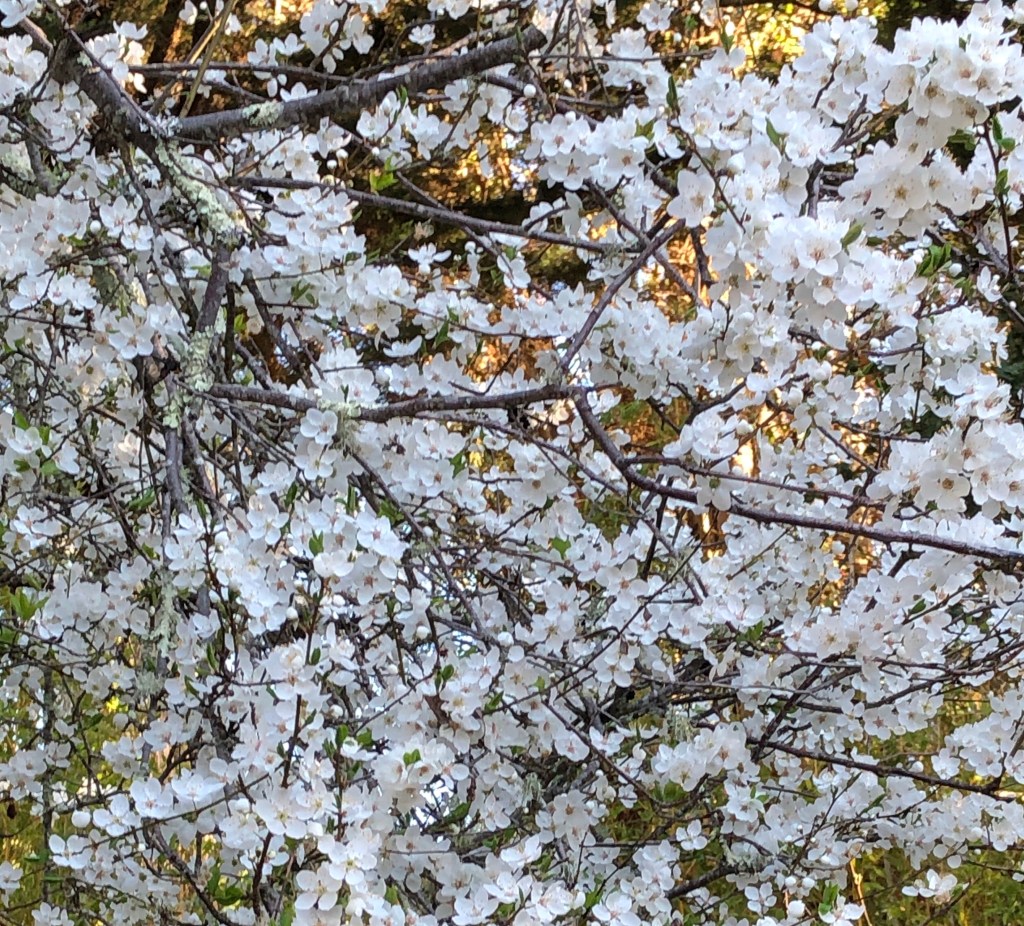
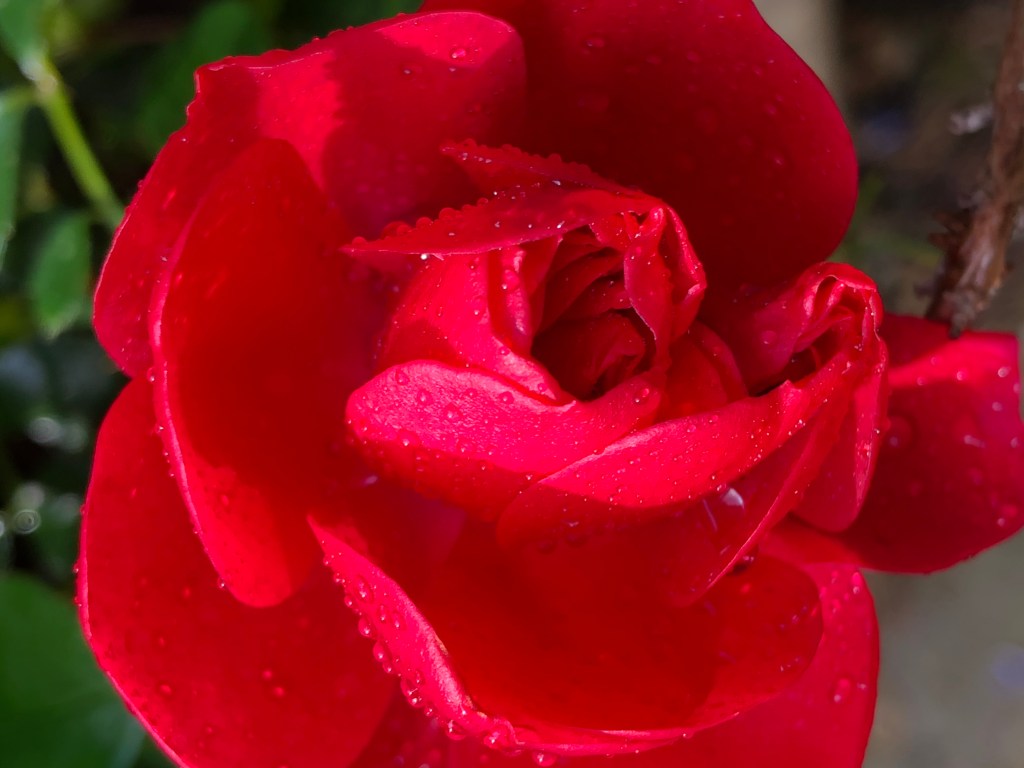
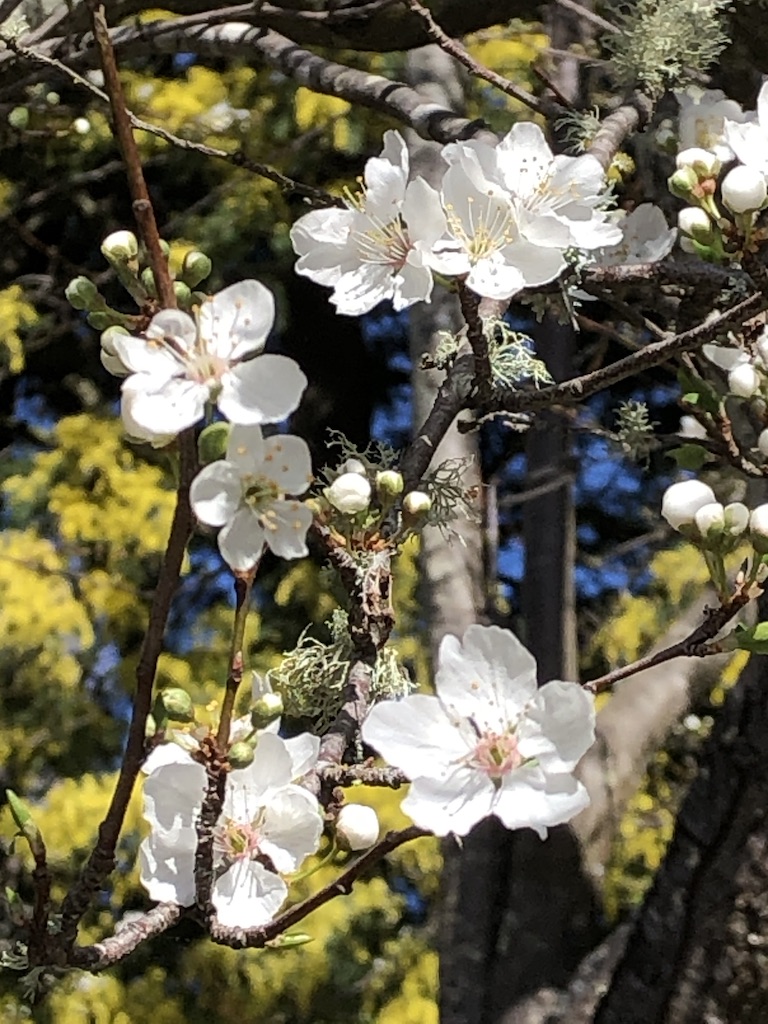
This morning I’m with the body, this body, and this wider body of which I’m part. Birds are singing and swinging across the sky as more and more blossoms emerge. My heart has wings and spring.
I come in from outside and watch a video of Thich Nhat Hanh. He says: Breathing in, I’m aware of my body – breathing out I release tensions in my body.”
This act of love allows us to address our suffering, and the suffering of our ancestors, and that understanding brings compassion, compassion for ourselves and the world.
He says: “Be aware of your body. Your body is a masterpiece of the cosmos. The consciousness of the cosmos. Do you have the capacity to appreciate the wonder that is your body? Mother Earth is in you. Not underneath, or all around you- but in you, also. Father sun is in you; you are made of sunshine. You are made of fresh air, of fresh water. To be aware of that wonder, to value that wonder can only bring you a lot of happiness… Understanding suffering always brings compassion that has the power to heal, and you suffer less.”
In her book Stalking Wild Psoas, Liz Koch, writes about Emilie Conrad, the founder of Continuum. Conrad says, “The fluid system is primary and not bound by the nervous system.” “The primary characteristic of any fluid system is its ability to keep transforming itself.”
As “a masterpiece of the cosmos”, we are fluid. We are not fixed.
I’ve mentioned Heather Cox Richardson and her column on the politics of the day. Today she gives a historical perspective of the two political parties in the U.S., and how though often opposite in approach, they cared about the country as a whole. It’s been a back and forth until now.
She writes:
In 1859, Illinois lawyer Abraham Lincoln, who had thrown in his lot with the Republicans, articulated a new ideology for the party. Drawing from the era’s rising political economists, he denied the Democratic idea that the world was divided between the haves and the have nots, and said instead that all Americans shared a harmony of interests. The government’s role was not to broker between two opposing forces, but rather to expand equality of opportunity and access to resources for poor men just starting out. As those men worked, they would produce capital—Republicans actually called capital “pre-exerted labor”—which they would use to buy goods, keeping the economy growing. When they made enough money, they would hire others just starting out, who would, in turn, begin to make money themselves. “The prudent, penniless beginner in the world, labors for wages awhile, saves a surplus with which to buy tools or land, for himself; then labors on his own account another while, and at length hires another new beginner to help him,” Lincoln said. “This… is free labor — the just and generous, and prosperous system, which opens the way for all — gives hope to all, and energy, and progress, and improvement of condition to all.”
As a country, the United States stands on a precipice. Do we allow an oligarchy or do we step up in the fullness of our fluidity and connectivity to honor the wholeness of the cosmos we are, and allow the wonder of this masterpiece to spring forth like buds and birds in this unfolding new season of the year?
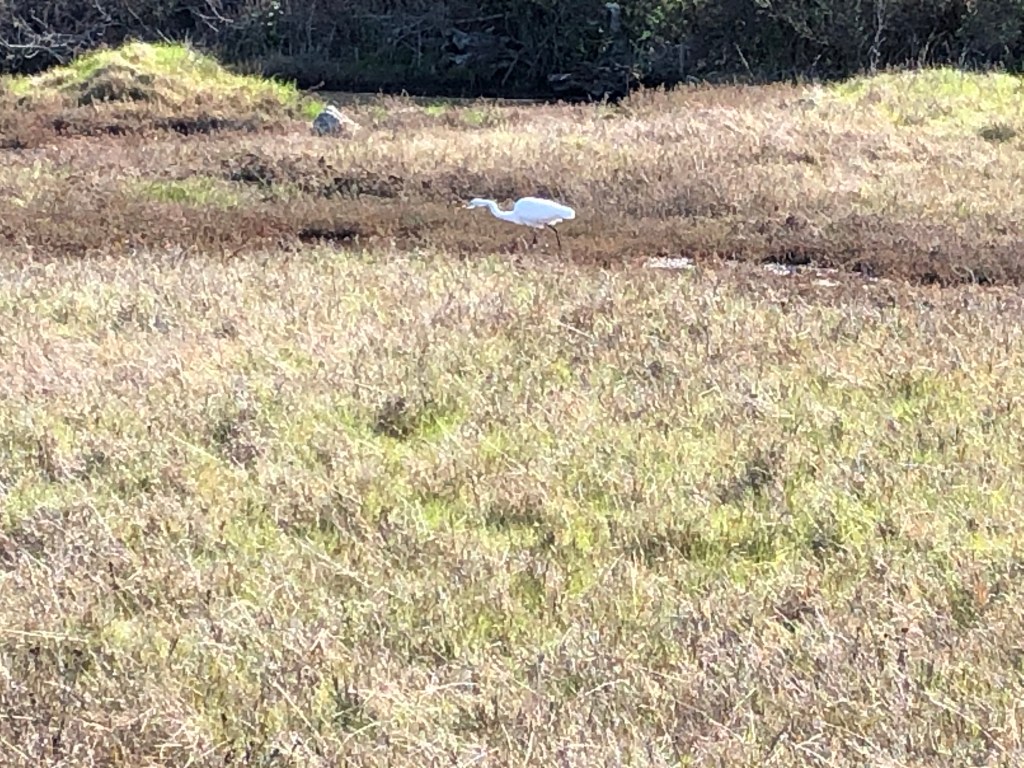
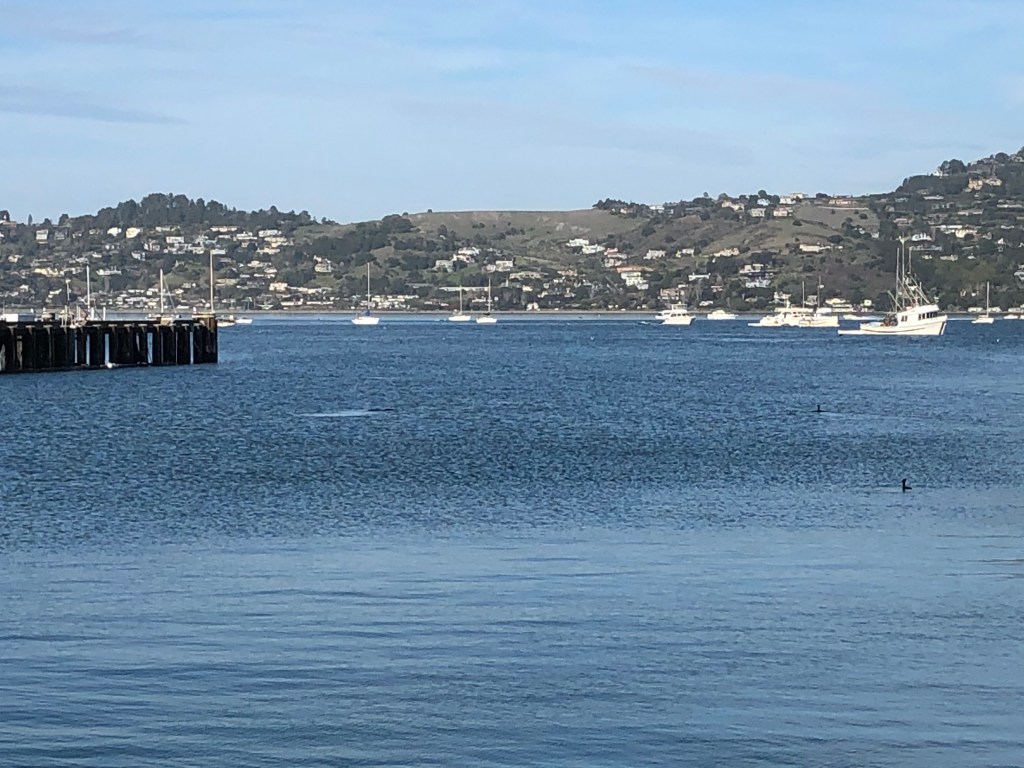
Do you see the seal and grebes?
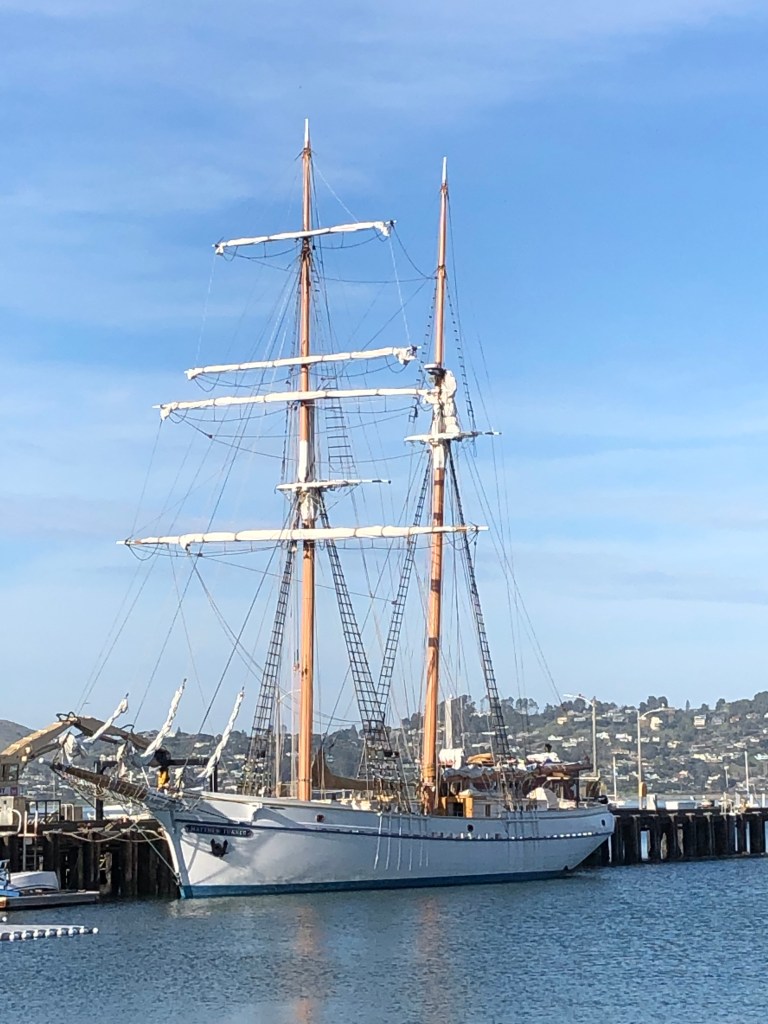
We can raise our sails or stay tucked and tied to the dock with no judgment of our choice.
I’ve been outside enjoying spring’s arrival when I come inside to read an article on therapy dogs and a pig at SFO. They wear harnesses that say “pet me” and are there to comfort and entertain. We live in a world of so much beauty. Touch. Receive.
 Cathy's Blog!